
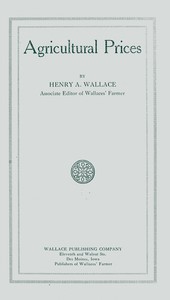
Agricultural prices by Henry A. Wallace
Okay, let's be clear from the start: 'Agricultural Prices' is not a beach read. It's a serious, data-driven analysis published in 1920. But don't let that scare you off. Think of it as the origin story for a huge piece of modern America.
The Story
There isn't a traditional plot with characters. Instead, the 'story' is the economic trap American farmers found themselves in after World War I. Wallace lays out the facts. Farmers had expanded production to feed a world at war. When peace came, demand plummeted, but their debts for land and equipment didn't. The book walks you through the numbers, showing how the price of a bushel of corn could fall below what it cost to grow it. He explains the 'price scissors'—where crop prices fall but the cost of manufactured goods (tractors, cloth, tools) stays high, squeezing farmers from both sides. The central conflict is the farmer against an unpredictable and often unfair market.
Why You Should Read It
You should read it because it makes history tangible. This isn't a dry policy paper; it's a diagnosis of a crisis by someone who lived it. Wallace writes with the precision of an economist and the empathy of a farmer. You feel the frustration in his explanations. What struck me most was how contemporary the core issues feel—the struggle for fair prices, the vulnerability to global markets, the tension between small family farms and larger economic forces. Reading this, you understand exactly why the Great Depression hit rural America first and hardest, and you see the blueprint for New Deal farm programs that Wallace would later help create.
Final Verdict
This book is perfect for history buffs, anyone interested in economics or food systems, and readers who enjoy primary sources. If you liked 'The Grapes of Wrath' for its social commentary, this is the non-fiction, ground-level report that explains the economics behind that despair. It's a challenging but rewarding look at a foundational American problem, written with clarity and a quiet passion for justice. You won't find thrilling twists, but you will find the key to understanding a century of farm policy and the real people behind it.
Legal analysis indicates this work is in the public domain. You are welcome to share this with anyone.
Patricia Anderson
6 months agoHaving followed this topic for years, I can say that the transition between theoretical knowledge and practical application is seamless. I am looking forward to the author's next publication.
Ashley Harris
6 months agoVery satisfied with the depth of this material.
George Lopez
2 years agoAs someone working in this industry, I found the insights very accurate.
Matthew Jones
7 months agoI started reading this with a critical mind, the case studies and practical examples provided add immense value. Definitely a five-star contribution to the field.






Susan Brown
4 months agoI stumbled upon this title during my weekend research and the practical checklists included are a great touch for real-world use. Simple, effective, and authoritative – what else could you ask for?