
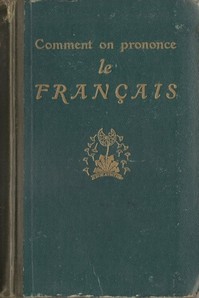
Comment on Prononce le Français by Philippe Martinon
Published in 1913, Philippe Martinon's book is a fascinating time capsule. It's not a story with characters, but a deep investigation into a problem: how do you actually speak French correctly? At the time, there was a big gap between what dictionaries said and how elegant Parisian society actually pronounced words. Martinon set out to document the real, living pronunciation of his era, acting more like a linguistic reporter than a stern schoolmaster.
The Story
Think of the 'story' as Martinon's quest. He walks us through the French alphabet, sound by sound, word by word. He points out the tricky parts—the silent letters that sometimes aren't silent, the liaisons that are mandatory versus those that are just pretentious, the regional variations creeping into Parisian speech. He gives clear, practical advice on vowels, consonants, and rhythm. The plot is his journey to pin down a language that was, and always is, in motion. He's trying to capture the sound of educated French at a very specific point in history, right before the world changed with World War I.
Why You Should Read It
This book is a treasure for anyone who loves language. It’s incredibly humbling. It shows that the 'perfect' French we might strive for today was different a century ago. Words we pronounce clearly now had softer, more elided sounds back then. It makes you realize that languages are living things, not frozen in dictionaries. For a learner, it’s a brilliant reminder not to get too stressed about 'perfection,' because even the experts were debating it. For a native speaker, it's a poignant echo of how their grandparents might have spoken. Martinon’s voice is clear and surprisingly modern—he’s not a dusty academic, but someone genuinely trying to help people communicate with grace and avoid sounding awkward.
Final Verdict
This is a niche gem, but a brilliant one. It's perfect for advanced French students or teachers who want to understand the 'why' behind pronunciation rules. History and linguistics nerds will geek out over the subtle changes it reveals. It's also great for curious readers who enjoy primary sources—it lets you listen in on an early 20th-century conversation about language, class, and identity. If you're looking for a casual beginner's guide, this isn't it. But if you want to go beneath the surface and feel the pulse of the French language in another time, Martinon’s work is a captivating and insightful guide.
This title is part of the public domain archive. Feel free to use it for personal or commercial purposes.
George Taylor
9 months agoAfter hearing about this author multiple times, it manages to explain difficult concepts in plain English. A true masterpiece.
Dorothy Anderson
1 year agoGood quality content.
Deborah White
4 months agoEnjoyed every page.




Joshua Brown
1 year agoEnjoyed every page.