
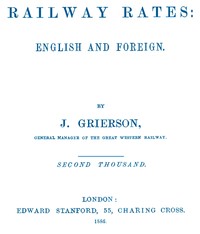
Railway Rates: English and Foreign by James Grierson
Published in 1886, Railway Rates: English and Foreign is James Grierson's detailed examination of how train companies set their prices. Grierson wasn't an outsider looking in; he was a senior railway manager with decades of hands-on experience. The book is his attempt to make sense of a system that, to the public and many businesses, seemed arbitrary and often unfair.
The Story
There's no traditional plot, but there is a clear narrative drive. Grierson acts as a guide through the tangled jungle of 19th-century railway economics. He starts by laying out the confusing mess of English rates, where different private companies could charge vastly different prices for moving the same goods over similar distances. He explains the complex classifications—why coal was priced one way and china another—and the frustrations this caused shippers. Then, he crosses the Channel. He paints a picture of the more uniform, state-managed systems in countries like France, Belgium, and Germany. The core of the book is this comparison. He isn't just listing prices; he's showing two competing philosophies for running a nation's critical infrastructure: chaotic private competition versus orderly public control.
Why You Should Read It
You should read it because it turns dust-dry policy into a genuine debate about power and fairness. Grierson writes with the conviction of someone who has seen the system's flaws from the inside. When he describes a farmer being ruined by unpredictable shipping costs, or the advantage given to large corporations over small businesses, you feel the human impact. His voice is surprisingly modern. The questions he wrestles with—should essential services be run for profit or the public good? How do you balance efficiency with equity?—are the same ones we ask about the internet, energy, and healthcare today. It's a masterclass in seeing the big social and political ideas hidden within technical, everyday details.
Final Verdict
This isn't for everyone. If you're looking for a relaxing story, look elsewhere. But if you're a history buff who loves seeing how the gears of society turn, or a policy wonk fascinated by the origins of modern debates, it's a hidden gem. It's also perfect for anyone interested in the Industrial Revolution, business history, or the quiet moments when people first started arguing about corporate power and regulation. Think of it as a primary source that reads like a passionate, well-informed op-ed from 1886. You'll come away with a new appreciation for the humble train ticket and the long battle over what it should really cost.
This historical work is free of copyright protections. You do not need permission to reproduce this work.
Barbara Thomas
2 years agoFive stars!
Jessica Hernandez
2 months agoPerfect.



Melissa Wilson
7 months agoA bit long but worth it.