1

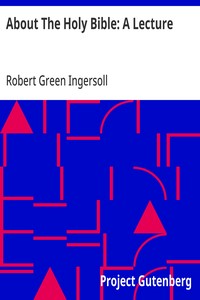
About The Holy Bible: A Lecture — Reading Companion
(0 User reviews)
793
Project Gutenberg
2011
Not confirmed
Bible -- Criticism, interpretation, etc.
Readers of public-domain and historical texts
Project Gutenberg digital edition
en
Edition facts
Words
15,922
Reading time
70 min
Text sections
3
For About The Holy Bible: A Lecture — Reading Companion, the stored edition analysis reports 15,922 words, 1 hr 10 min estimated reading time, and 3 detected text sections.
The text analysis averages about 17.9 words per sentence, while the detected sections provide another way to judge how the source is divided.
Project Gutenberg metadata also associates the work with “Bible -- Criticism, interpretation, etc.,” connecting these edition facts with the source record’s subject description.
Source:
Project Gutenberg record #37703
Ingersoll's lecture dissects the Bible's origins, contradictions, and claims of inspiration, using specific textual discrepancies to argue against divine authorship.
Read the complete public-domain text at its original source.
Read on Project GutenbergRobert G. Ingersoll opens his lecture by noting that millions regard the Bible as "staff and guide, counselor and consoler," yet he immediately counters that they "forget its ignorance and savagery, its hatred of liberty." This rhetorical strategy—juxtaposing reverence with critique—sets the tone for a systematic examination of the Bible's origins and internal inconsistencies. Ingersoll moves from the Pentateuch's composition to the Gospels' conflicting accounts, grounding his arguments in specific verses and historical context.
The Desert Origin and the Claim of Revelation
Ingersoll begins by situating the Old Testament's formation among "a few wandering families" recently escaped from slavery, illiterate and without a written language. He emphasizes that Moses, raised in Pharaoh's court, "pretended that he was instructed and assisted by Jehovah" to control his followers. The lecture highlights that the Jewish religion and Mosaic Code were established in isolation, with no means to disseminate a universal revelation. Ingersoll repeatedly stresses the lack of contemporary corroboration: the wanderers had "no commerce with other nations" and could not read or write. This framing undercuts the claim of divine origin by presenting the Bible as a product of specific, limited human circumstances.
Contradictions in the Resurrection and Ascension
Ingersoll zeroes in on the Gospels' divergent accounts of the Ascension. He quotes Mark's version, where Christ gives final instructions and is "received up into heaven," then contrasts it with Luke's terse statement that "he was parted from them and carried up into heaven." The Acts of the Apostles adds that "a cloud received him out of their sight." Ingersoll asks pointedly: "Is it possible that this description was written by one who witnessed this miracle?" He notes that neither Matthew nor John records the conversation Mark attributes to Christ, and that the Ascension story developed gradually—first Christ was merely a man, then the son of God, then resurrected, then ascended. This progression, he argues, reveals the legend's fabrication.
Miracles and the Silence of the Cured
The lecture catalogs miracles across the Gospels: Matthew lists about twenty-two, Mark nineteen, Luke eighteen, and John seven. Ingersoll observes that only Matthew mentions the Star and the Wise Men, only John recounts Lazarus's resurrection, and only Luke tells of raising the widow of Nain's son. He then poses a devastating objection: "The Jews, among whom they were said to have been performed, did not believe them. The diseased, the palsied, the leprous, the blind who were cured, did not become followers of Christ. Those that were raised from the dead were never heard of again." This pattern of unsubstantiated claims, he implies, undermines the Gospels' reliability as historical documents.
The Evolution of Christology in the Gospels
Ingersoll traces a development in early Christian belief: "At first Christ was a man—nothing more. Mary was his mother, Joseph his father." Genealogies were supplied to link him to David. Later, the virgin birth was asserted, then the resurrection, then the bodily ascension. Ingersoll argues that "it required many years for these absurdities to take possession of the minds of men." He questions why the risen Christ did not appear to his enemies or ascend publicly, calling the Ascension "a miracle that could have been seen by a vast multitude—a miracle that could not be simulated." The secrecy, he contends, points to interpolation and later invention rather than eyewitness testimony.
The Question of Interpolation
Ingersoll repeatedly charges that the Gospels and epistles contain interpolations—later additions that inflated Jesus's divinity. He notes that after the resurrection story emerged, the Ascension "became a necessity. They had to dispose of the body." This logical pressure, he suggests, drove the creation of new narratives. The lecture does not specify which passages are interpolated, but the cumulative effect of pointing out discrepancies—such as the Ascension accounts—implies that the New Testament is not a unified, inspired work but a patchwork of evolving traditions.
Ingersoll's lecture is best approached as a courtroom-style cross-examination of the Bible's internal evidence. Readers should attend to how he selects and juxtaposes verses, and note his reliance on logical inference rather than external sources. The lecture does not attempt to disprove the Bible's moral value but to challenge its claim to supernatural origin. Those interested in nineteenth-century freethought or rhetorical analysis will find Ingersoll's method as instructive as his conclusions.
Reading Ingersoll’s lecture, I felt that familiar ache of dismantled certainty—how strange to hold a book so flawed and still feel its weight. It reminded me of evenings spent with The London Pulpit — Story, Setting & Ideas, where sermons breathe human doubt rather than divine command. Both texts linger like old friends who’ve lost their faith but kept their warmth.
There are no reviews for this eBook.
There are no comments for this eBook.
Reader reflection
What was your reading experience?
Capture what you thought, learned, and would like to remember.
Your progress
0
/
10
2
How did the book work for you overall?
3
Would you pass this book on to a friend?
4
How demanding did the text feel?
5
What was the strongest part of the book?
6
How well did it match your expectations?
7
How would you rate its originality?
8
Would this book work well in a reading group?
9
Which lesson or insight stayed with you?
10