1

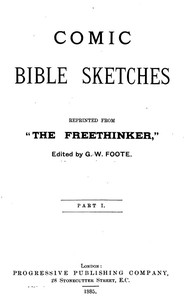
Comic Bible Sketches, Reprinted from "The Freethinker" — A Closer Reading
(0 User reviews)
427
Project Gutenberg
2009
Not confirmed
Free thought; Bible -- Caricatures and cartoons
Readers of public-domain and historical texts
Project Gutenberg digital edition
en
Edition facts
Words
5,303
Reading time
24 min
Text sections
1
Comic Bible Sketches, Reprinted from "The Freethinker" — A Closer Reading can be approached with a clearer sense of reading commitment from its source measurements: 5,303 words, 24 min estimated reading time, and 1 detected text section.
The text analysis averages about 25.5 words per sentence, while the detected sections provide another way to judge how the source is divided.
Project Gutenberg metadata also associates the work with “Free thought,” connecting these edition facts with the source record’s subject description.
Source:
Project Gutenberg record #30210
G. W. Foote's 1885 collection of satirical Bible illustrations, originally published in the freethought periodical The Freethinker, adapts French anticlerical cartoons for a British audience, mixing irreverent humor with pointed criticism of biblical narratives and Victorian piety.
Read the complete public-domain text at its original source.
Read on Project GutenbergG. W. Foote's Comic Bible Sketches opens with a combative introduction that situates the work within a tradition of irreverent English humor—comic histories, grammars, and law-books—while invoking Carlyle's horrified prophecy of a 'Comic Bible.' Foote traces his project to French precedents, notably La Bible Amusante, and explains how the Freethinker adapted these for a British readership, filtering out what he calls 'Gallic flavor' while retaining the satirical edge. The introduction also recounts the legal persecution of the Freethinker, with its editor, proprietor, and publisher receiving prison sentences for blasphemy, framing the sketches as acts of defiance against religious censorship.
French Origins and British Adaptations
Foote is explicit about his sources: the French La Bible Amusante provided a template, but many of its drawings could not be reproduced directly in England due to their 'Gallic flavor.' A Parisian artist treating biblical histories 'which our youths and maidens discover with unerring instinct' was deemed too risqué for the 'pious and chaste British public.' Instead, the Freethinker artist used the French originals as a basis, copying some closely, elaborating and adapting others 'to our national taste,' and using some as 'a central suggestion' for independent treatment. This layered process of translation and adaptation—toning down sexual content while sharpening theological mockery—shapes the collection's distinctive voice.
Legal Risks and Rhetorical Strategy
Foote's introduction repeatedly underscores the legal dangers of his project. He notes that the Freethinker was 'prosecuted twice for Blasphemy,' resulting in prison terms of twelve, nine, and three months for those involved—punishments he sarcastically attributes to 'the glory and honor of God.' This context of persecution informs the sketches' rhetorical strategy: they are not merely humorous but deliberately provocative, testing the boundaries of Victorian blasphemy law. Foote frames his work as a continuation of the freethought movement's campaign to 'remove those ancient Jews who still infest our mental thoroughfares,' a metaphor that blends anti-clericalism with a call for intellectual liberation.
Visual and Verbal Irony in the Excerpts
Although the full illustrations are not reproduced in the text excerpts, the introduction and repeated 'ENLARGE' prompts indicate a work where images carry much of the satirical weight. Foote's prose itself employs ironic contrasts: he describes the Freethinker as 'a scandalous print, as the Christians love to describe it,' then immediately details the severe punishments meted out to its staff. This technique of quoting opponents' language while subverting it recurs throughout. The sketches likely juxtapose biblical scenes with modern, mundane, or grotesque details, a method Foote hints at when he mentions 'disporting himself among those highly moral histories'—a phrase that suggests playful irreverence toward sacred narratives.
Readers should approach Comic Bible Sketches as a historical artifact of Victorian freethought activism, where humor served as both weapon and shield. The sketches are best understood alongside the legal and cultural context Foote provides: they are not merely jokes but interventions in a heated public debate over blasphemy, censorship, and the authority of scripture. Pay attention to how the images and captions work together to defamiliarize familiar stories, and consider what the French-to-British adaptation reveals about differing thresholds of irreverence.
I found myself smiling over Foote’s old cartoons, their gleeful poking at Victorian piety, and yet a quieter thought crept in—how much earnest weight sat on those same pews. My mind drifted to a sterner, graver volume, A Body of Divinity, Vol. 1 (of 4) Wherein the doctrines of the Christian religion are explained and defended, being the substance of several lectures on the Assembly's — Reading Companion, which once felt like the very opposite of laughter’s release.
There are no reviews for this eBook.
There are no comments for this eBook.
Reader reflection
How will you remember this book?
Save your reaction, strongest insight, and memorable passage.
Your progress
0
/
10
2
How much did you enjoy the reading experience?
3
Would you encourage someone else to read it?
4
Did the language feel accessible?
5
Was the book what you thought it would be?
6
How strongly did the book affect you emotionally?
7
How personally connected did you feel to the book?
8
Could you apply anything you learned?
9
What changed or sharpened your thinking?
10