1

Forerunners and rivals of Christianity — Reading Notes
(0 User reviews)
981
Project Gutenberg
2023
Not confirmed
Christianity and other religions; Religions
Readers of public-domain and historical texts
Project Gutenberg digital edition
en
Edition facts
Words
102,059
Reading time
444 min
Text sections
22
Forerunners and rivals of Christianity — Reading Notes can be approached with a clearer sense of reading commitment from its source measurements: 102,059 words, 7 hr 24 min estimated reading time, and 22 detected text sections.
The text analysis averages about 20.0 words per sentence, while the detected sections provide another way to judge how the source is divided.
Project Gutenberg metadata also associates the work with “Christianity and other religions,” connecting these edition facts with the source record’s subject description.
Source:
Project Gutenberg record #71384
Francis Legge's 1915 study examines religious movements from 330 BC to 330 AD, focusing on fragmentary documents like magic papyri to reveal how pagan, Jewish, and Christian ideas intertwined in the Hellenistic world.
Read the complete public-domain text at its original source.
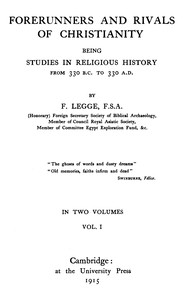
Read on Project GutenbergFrancis Legge opens his study with an epigraph from Swinburne—'The ghosts of words and dusty dreams'—that signals his method: assembling scattered, often obscure documents to reconstruct the religious landscape of the Hellenistic era. Rather than narrating a smooth history, he follows the advice of Egyptologist Gaston Maspero: collect every fragment, set them side by side, and let common features emerge. The result is a work that treats magic papyri, mystery cult texts, and philosophical treatises as equally valuable evidence for the 'forerunners and rivals' of Christianity.
Assembling Fragments
Legge’s preface explicitly frames his project as a collection of 'scattered and diverse examples' that are 'all fragmentary' and 'difficult to understand without a running commentary.' He does not claim to have found a unified narrative; instead, he hopes that as more fragments come to light, 'those points which are still obscure may be made clear.' This cautious, empirical stance distinguishes his work from more sweeping histories of early Christianity. The reader is invited to watch patterns form across texts that range from Egyptian magical formulas to Gnostic invocations, without expecting a single coherent story.
The Texture of Magical Practice
One excerpt details a ritual for 'autoptic lecanomancy'—divination by a bowl of liquid. The instructions are precise: use 'living' water for celestial gods, seawater for terrestrial ones, river water for Osiris or Sarapis, and well water for the dead. The magician must wear white garments, burn frankincense, and recite a 'hundred-lettered name' that makes 'the earth, the abyss, Hades, heaven, the sun, the moon, the place of the stars and the whole phenomenal universe' tremble. Legge notes that this charm 'amply bears out' Iamblichus’s remark that Egyptian magicians 'were accustomed in their spells to threaten the gods.' The passage reveals a worldview where divine powers are not merely supplicated but compelled through correct pronunciation and ritual action.
Typhon and the Hostile Powers
Legge identifies Typhon—the Greek equivalent of the Egyptian Set—as 'essentially a power of darkness and evil' in Hellenistic times. The magic papyrus treats him as a force 'hostile alike to man and to the beneficent gods,' yet the magician dares to invoke him, commanding him to appear. This tension between fear and control runs through many of the texts Legge examines. He does not resolve it; instead, he presents the evidence as it stands, letting the reader see how practitioners navigated a cosmos filled with both friendly and dangerous beings. The 'phylactery'—a silver plate inscribed with the hundred-lettered name and worn on ass’s skin—illustrates how material objects were believed to channel this power.
Legge’s volume is best approached as a cabinet of curiosities rather than a linear argument. Readers willing to move slowly through the incantations, footnotes, and cross-references will find a richly textured world where the boundaries between religion, magic, and philosophy blur. The second volume continues the survey, but even this first installment offers a rare glimpse into the raw materials of religious innovation in the ancient Mediterranean.
I keep thinking about how Francis Legge traced those old fragmentary papyri, the way beliefs bled into one another back then. It reminded me that doctrine wasn’t always so tidy. Later I stumbled onto A Body of Divinity, Vol. 1 (of 4) Wherein the doctrines of the Christian religion are explained and defended, being the substance of several lectures on the Assembly's — Reading Companion, and it felt like the same questions, only answered more gently.
There are no reviews for this eBook.
There are no comments for this eBook.
Reader reflection
Record your reading impressions
A brief reflection can help important ideas stay with you longer.
Your progress
0
/
10
2
What was your overall reaction to the book?
3
Would you recommend this book to another reader?
4
How demanding did the text feel?
5
How much did the book move you?
6
Did the book give you something worth debating?
7
How did the reading compare with what you expected?
8
How closely did the book connect with your experience?
9
What did this book teach you most?
10