1

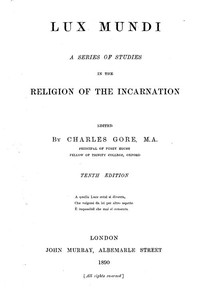
Lux Mundi: A Series of Studies in the Religion of the Incarnation, 10th Edition, 1890 — Inside the Classic
(0 User reviews)
2820
Project Gutenberg
2014
Not confirmed
Christianity; Incarnation
Readers of public-domain and historical texts
Project Gutenberg digital edition
en
Edition facts
Words
217,063
Reading time
944 min
Text sections
23
This digital edition of Lux Mundi: A Series of Studies in the Religion of the Incarnation, 10th Edition, 1890 — Inside the Classic is described by source-level measurements including 217,063 words, 15 hr 44 min estimated reading time, and 23 detected text sections.
The text analysis averages about 26.8 words per sentence, while the detected sections provide another way to judge how the source is divided.
Project Gutenberg metadata also associates the work with “Christianity,” connecting these edition facts with the source record’s subject description.
Source:
Project Gutenberg record #46478
This 1890 collection of twelve essays by Oxford theologians, edited by Charles Gore, attempts to reconcile Catholic faith with modern intellectual challenges through careful attention to diction and argumentative structure.
Read the complete public-domain text at its original source.
Read on Project GutenbergThe preface to the tenth edition of Lux Mundi opens with a striking claim: the volume is 'primarily due to a set of circumstances which exists no longer.' This temporal specificity—anchored to the Oxford years 1875–1885—immediately signals that the essays are not abstract theology but a response to a particular intellectual moment. The editor, Charles Gore, and his contributors were 'compelled for their own sake, no less than that of others, to attempt to put the Catholic faith into its right relation to modern intellectual and moral problems.' The language here is careful: 'compelled' suggests necessity, not choice, and 'right relation' implies a deliberate, reasoned adjustment rather than a wholesale revision.
A Collaborative Voice
The preface emphasizes that the essays emerged from 'common work of University education' and 'not infrequent meetings' that produced 'a common body of thought and sentiment, and a common method of commending the faith.' This collaborative origin is reflected in the essays' consistent tone: they are argumentative but not confrontational, learned but accessible. The contributors—including H. S. Holland, Aubrey Moore, and J. R. Illingworth—were all Oxford figures, and their shared context shapes the volume's approach. The preface's claim that the writers are now 'for the most part separated' adds a note of wistfulness, as if the book is a record of a lost intellectual fellowship.
The Language of Accommodation
One of the volume's key rhetorical strategies is its willingness to concede points to critics while maintaining doctrinal boundaries. For instance, the essay on the Church acknowledges that 'Church people and Church rulers have too often been the stumbling-block' and that 'intellectual apathy, and stern moral proscription of every form of mental difficulty' have driven 'living and growing intelligence out of the Church.' This is not a blanket apology but a specific critique of institutional failures. Similarly, the discussion of creeds admits that 'the instruments which, perforce, we make use of upon earth, even in the Creeds of the Church, are necessarily imperfect instruments.' The word 'perforce' is telling: it suggests that human language is inherently inadequate for divine truths, yet the creeds remain necessary.
Tension Between Certainty and Humility
The essays repeatedly navigate a tension between claiming the creed as 'a complete and sufficient statement of truth' and acknowledging its 'relative and temporary' character. The writer on the Athanasian Creed argues that the creeds are 'temporary, in that they are a complete and sufficient statement of truth only for time.' This paradoxical formulation—complete yet temporary—reflects a careful balancing act. The language of 'trammels and limits of earthly thought and expression' recurs, suggesting that the authors are acutely aware of the constraints of human language. They insist on the creeds' adequacy for earthly purposes while leaving room for 'the perfect light and knowledge of the presence of God' to supersede them.
Concrete Examples of Doctrinal Language
The excerpts provide specific instances of how the authors handle doctrinal terminology. In discussing the Holy Spirit, the text quotes the phrase 'The Holy Ghost is of the Father and of the Son: neither made, nor created, nor begotten, but proceeding.' The authors then question whether we need 'fear to own that the instruments which, perforce, we make use of upon earth, even in the Creeds of the Church, are necessarily imperfect instruments.' This self-reflexive move—using a creedal formula to question the adequacy of creedal language—is characteristic of the volume's method. The authors also mention 'glosses and materialisms' that can distort understanding, indicating a concern with how doctrine is received and interpreted.
Readers approaching Lux Mundi will find a work that is both historically situated and theologically ambitious. The essays reward attention to their precise diction and argumentative structure, as the authors consistently qualify their claims without abandoning them. The volume is best read as a series of interconnected arguments rather than isolated pieces; the preface's emphasis on a 'common body of thought' invites the reader to trace recurring concerns across the essays.
I keep returning to the 1890 Lux Mundi, its careful diction making old faith feel newly breathable. That quiet urgency reminded me of The Expositor's Bible: The Prophecies of Jeremiah With a Sketch of His Life and Times — Context and Discussion, where prophecy reads less like prediction and more like a long, held sigh. Both works share that same unhurried wrestling with doubt, so tender it almost feels private.
There are no reviews for this eBook.
There are no comments for this eBook.
Reader reflection
Record your reading impressions
A brief reflection can help important ideas stay with you longer.
Your progress
0
/
10
2
How much did you enjoy the reading experience?
3
How likely are you to recommend this book?
4
How easy was the book to follow?
5
How useful were the ideas in this book?
6
Did the book offer a fresh perspective?
7
Did any part of the book feel personally relevant?
8
How understandable was the text?
9
What did this book teach you most?
10