1

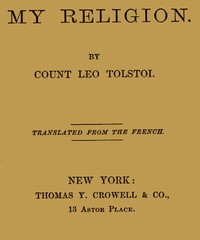
My Religion — A Reader’s Guide
(0 User reviews)
915
Project Gutenberg
2013
Not confirmed
Christianity
Readers of public-domain and historical texts
Project Gutenberg digital edition
en
Edition facts
Words
76,650
Reading time
334 min
Text sections
8
Before opening My Religion — A Reader’s Guide, the edition data offers a quick orientation: 76,650 words, 5 hr 34 min estimated reading time, and 8 detected text sections.
The text analysis averages about 24.8 words per sentence, while the detected sections provide another way to judge how the source is divided.
Project Gutenberg metadata also associates the work with “Christianity,” connecting these edition facts with the source record’s subject description.
Source:
Project Gutenberg record #43794
Tolstoy's radical reinterpretation of Christianity, arguing that Jesus's true teaching is about living for the 'son of man'—humanity—rather than personal salvation or bodily resurrection. The book challenges institutional doctrines and emphasizes practical service to others as the path to eternal life.
Read the complete public-domain text at its original source.
Read on Project GutenbergIn My Religion, Tolstoy strips away centuries of ecclesiastical interpretation to confront what he sees as the core of Jesus's message: the command to live not for oneself but for the 'son of man'—a term he uses to denote the collective life of humanity. The excerpts reveal a relentless focus on the practical, this-worldly implications of the Gospels, as Tolstoy insists that eternal life is not a future reward but a present reality achieved through selfless service. He repeatedly denies the doctrine of personal resurrection, citing Jesus's words to the Sadducees: 'He is not the God of the dead, but the God of the living.' This is not a devotional work but a polemical one, aimed at dismantling what Tolstoy regards as superstitions that have obscured the radical ethical demands of Christianity.
The 'Son of Man' as a Collective Ideal
Tolstoy's central interpretive move is to read the phrase 'son of man' not as a title for Jesus alone but as a designation for every person's true life, which is lived in unity with all humanity. He writes that 'the life of the son of man has been given to all men, and they know not why.' This collective understanding transforms the parable of the talents: the servants who 'labored for the good of the master' are those who use their lives for the benefit of the whole. Tolstoy insists that Jesus's teaching is not about individual salvation but about aligning one's life with the universal human community. The 'son of man' becomes a kind of corporate personality, and serving the hungry, thirsty, and wretched is serving that greater self. This interpretation allows Tolstoy to sidestep traditional Christological debates and ground ethics in a concrete, social imperative.
Denial of Personal Resurrection
A striking feature of the excerpts is Tolstoy's repeated and emphatic denial of individual resurrection. He claims that Jesus 'not only said nothing in affirmation of individual resurrection and individual immortality beyond the grave, but on the contrary, every time that he met with this superstition ... he did not fail to deny its truth.' To support this, Tolstoy points to Jesus's response to the Sadducees, where he argues that the dead are 'living in God'—not as separate souls but as those who have lived the life of the son of man. For Tolstoy, the only resurrection is the ongoing life of those who have served humanity; they are 'united to God' in a way that transcends biological death. This position places him in direct opposition to mainstream Christian eschatology and reveals his commitment to a this-worldly, ethical religion over supernatural promises.
The Authority of Personal Interpretation
Throughout the excerpts, Tolstoy exercises a striking independence from established theological authorities. He does not cite church councils, creeds, or commentators; instead, he reads the Gospels as if encountering them for the first time. His method is to isolate what he considers the authentic core of Jesus's teaching—the command to serve the son of man—and to discard everything that conflicts with it, including the doctrine of the resurrection. This approach is evident in his handling of the parable of the talents, which he interprets without reference to traditional allegorical readings. The translator's preface notes that Tolstoy was 'acknowledged by competent critics to be a man of extraordinary genius,' but the text itself shows a writer who trusts his own moral intuition over received dogma. Readers should be prepared for a work that is as much a critique of institutional Christianity as an exposition of faith.
Tolstoy's My Religion is best approached as a philosophical argument rather than a devotional guide. The excerpts suggest a writer who is impatient with metaphysical speculation and focused on the practical transformation of life. Readers interested in the development of Tolstoy's later thought—especially his turn toward non-resistance and simplicity—will find the seeds of those ideas here. The book rewards careful attention to its scriptural reasoning, even—or especially—when that reasoning diverges from familiar interpretations.
Tolstoy’s My Religion taught me that Job’s anguish isn’t a puzzle to solve but a companion in the dark. Both books whisper that faith survives not in answers, but in the honest asking. I’ve often placed them side by side, old friends who never argue—just sit quietly together, sharing the same patient ache for meaning, like The Sceptics of the Old Testament: Job - Koheleth - Agur — Context and Discussion beside a well-worn Tolstoy.
There are no reviews for this eBook.
There are no comments for this eBook.
Reader reflection
Record your reading impressions
A brief reflection can help important ideas stay with you longer.
Your progress
0
/
10
2
What was your overall reaction to the book?
3
Would you encourage someone else to read it?
4
Did the language feel accessible?
5
What was the strongest part of the book?
6
Did the story or argument move comfortably?
7
Did anything about the book feel genuinely new?
8
How personally connected did you feel to the book?
9
Which lesson or insight stayed with you?
10