1

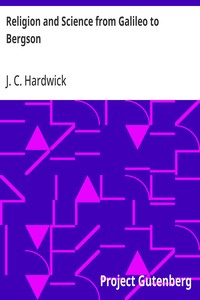
Religion and Science from Galileo to Bergson — Story, Setting & Ideas
(0 User reviews)
1109
Project Gutenberg
2011
Not confirmed
Religion and science
Readers of public-domain and historical texts
Project Gutenberg digital edition
en
Edition facts
Words
42,311
Reading time
184 min
Text sections
6
The source record for Religion and Science from Galileo to Bergson — Story, Setting & Ideas measures this digital text at 42,311 words, 3 hr 4 min estimated reading time, and 6 detected text sections.
The text analysis averages about 21.0 words per sentence, while the detected sections provide another way to judge how the source is divided.
Project Gutenberg metadata also associates the work with “Religion and science,” connecting these edition facts with the source record’s subject description.
Source:
Project Gutenberg record #35772
An editorial note examining the structure, recurring images, and movement between scenes in J. C. Hardwick's 1920 survey of the evolving relationship between religion and science from Galileo to Bergson, based on the preface and selected excerpts.
Read the complete public-domain text at its original source.
Read on Project GutenbergHardwick opens his preface with a modest disclaimer: his chapters are not a sketch of intellectual history since the Renaissance but an illustration of the thesis that humanity, being 'incurably religious,' insists on interpreting the universe spiritually. This framing immediately establishes a dialectical structure: each chapter pairs a scientific advance with a philosophical or religious reaction. The excerpts show a consistent pattern of movement from a scientific discovery (e.g., Copernicus, Darwin) to its philosophical implications and then to the religious response, creating a rhythmic alternation between empirical evidence and spiritual interpretation.
The Dialectical Architecture
The book's structure is built on a series of oppositions. Chapter II, 'The Dissolution of the Old Synthesis,' describes the medieval world-scheme and its unravelling by Copernicus, Bruno, and Galileo. Chapter III then presents the 'Growth of the Mechanical Theory' through Descartes and Newton. This pattern repeats: each scientific or philosophical position is followed by a reaction—Chapter IV covers 'Seventeenth-Century Reaction.' The excerpts from later chapters show the same rhythm: Darwin's theory of natural selection is presented as an extension of mechanism, then Chapter IX examines 'Materialism and Agnosticism' as its philosophical outcome. Hardwick does not merely list thinkers; he stages a debate, moving from thesis to antithesis and hinting at a synthesis yet to come.
Recurring Images of Mechanism and Mystery
Two opposing images recur throughout the excerpts. The first is the 'mechanical theory' or 'automatic universe,' associated with Newton's laws and Darwin's natural selection. Hardwick describes Darwin's theory as 'an extension of the mechanical theory' and notes that it 'seemed to be as valid... as Newton's law of gravity.' The second image is that of mystery: the preface quotes Bradley on 'the ineffable mystery of life,' and Hardwick repeatedly uses the word 'mystery' to describe what science cannot explain—the origin of variation, the nature of mind. This binary of mechanism versus mystery structures the argument, with each chapter showing how scientific progress reduces mystery but never eliminates it.
Movement Between Scenes: From Laboratory to Philosophy
Hardwick's narrative moves fluidly between scientific discovery and philosophical reflection. In the Darwin chapter, he shifts from the 'flash of insight' experienced by Wallace to the 'behaviour of the two men' in presenting their theory, then to the 'results of Darwin's theory' for thought. This movement is not merely chronological but conceptual: each scientific scene (Galileo's telescope, Darwin's notebooks) is followed by a philosophical scene (Descartes' extension of mechanism, the rise of materialism). The excerpts show Hardwick using transitional phrases like 'From Science to Philosophy' (Chapter IX) to signal these shifts. The effect is a continuous oscillation between empirical evidence and its interpretation, mirroring the book's central tension.
The Role of the Preface as a Structural Key
The preface provides a crucial lens for understanding the book's structure. Hardwick states that only 'a few typical names' appear, and he acknowledges omissions—Boehme is ignored, Martineau and the Cairds are passed over. This selectivity is deliberate: the book is not a comprehensive history but an argument. The preface also reveals the author's personal context: written in Altringham in March 1920, with acknowledgments to Dr. Mercer, Principal Major, and Rev. Harvey. This situates the work in a specific intellectual milieu—Anglican theological circles engaged with modern science. The structure, then, is not neutral but designed to support a thesis about the persistence of religious interpretation.
Readers approaching Hardwick's book will benefit from attending to its structural rhythm: each chapter pairs a scientific advance with a philosophical or religious reaction, creating a dialectical movement that mirrors the ongoing debate. The recurring imagery of mechanism versus mystery provides a thematic thread, while the preface offers a candid statement of the author's selective method. By tracing these patterns, one can appreciate how Hardwick constructs his argument without needing to accept his conclusions.
Years shelving J. C. Hardwick’s survey, I often recall how faithfully it traces humanity’s long, patient arguments with the unseen. That same quiet wrestling lives in the old prophet’s pages. Both volumes sit side by side now, whispering their shared secret: that every generation must re-learn its own doubts. The Expositor's Bible: The Prophecies of Jeremiah With a Sketch of His Life and Times — Context and Discussion holds that ache tenderly, as a familiar friend might.
There are no reviews for this eBook.
There are no comments for this eBook.
Reader reflection
Record your reading impressions
A brief reflection can help important ideas stay with you longer.
Your progress
0
/
10
2
Was reading this book enjoyable?
3
Is this a title you would suggest to others?
4
What was the reading difficulty like?
5
How clear did the writing feel?
6
How strongly did the book affect you emotionally?
7
Could you apply anything you learned?
8
Do you expect to return to this book?
9
What is the main idea you are taking away?
10