1

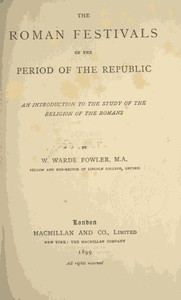
The Roman Festivals of the Period of the Republic An Introduction to the Study of the Religion of the Romans — A Closer Reading
(0 User reviews)
876
Project Gutenberg
2019
Not confirmed
Rome -- Religion; Cults -- Rome; Festivals -- Rome
Readers of public-domain and historical texts
Project Gutenberg digital edition
en
Edition facts
Words
142,851
Reading time
622 min
Text sections
46
The Roman Festivals of the Period of the Republic An Introduction to the Study of the Religion of the Romans — A Closer Reading can be approached with a clearer sense of reading commitment from its source measurements: 142,851 words, 10 hr 22 min estimated reading time, and 46 detected text sections.
The text analysis averages about 17.8 words per sentence, while the detected sections provide another way to judge how the source is divided.
Project Gutenberg metadata also associates the work with “Rome -- Religion,” connecting these edition facts with the source record’s subject description.
Source:
Project Gutenberg record #59007
An editorial note on how W. Warde Fowler's commentary on the Roman calendar uses the Fasti to structure a study of Republican religion, with observations on his method, use of evidence, and treatment of deities like Faunus.
Read the complete public-domain text at its original source.
Read on Project GutenbergW. Warde Fowler’s study of Roman Republican religion is organized as a commentary on the Fasti, the ancient Roman calendar. In his preface, he explains that he found this arrangement necessary after discovering that the ‘scrappy’ character of the source material required a thread on which to hang the fragments. The calendar, as edited by Mommsen in the Corpus Inscriptionum Latinarum, provided that thread. Fowler’s method is thus to follow the year’s festivals in order, treating each separately. This approach, he argues, is the only sound one for exhibiting the religious side of the native Roman character without becoming entangled in the later ‘colluvies religionum’ of the late Republic and early Empire.
A Method Shaped by Sources
Fowler’s preface reveals a scholar adapting to physical limitations: he turned to Roman ritual after bad eyesight forced him to abandon a project on Plutarch. The Quaestiones Romanae first sparked his interest, but the fragmentary nature of the evidence led him to seek a structural framework. He found it in the Fasti, and later in Roscher’s Lexicon, which made him redo his work. This backstory is not merely personal; it explains the book’s character as a compressed commentary that nonetheless engages with conflicting scholarly views. Fowler notes that compression was unavoidable, yet he still discusses the disagreements of eminent scholars, making the work as much a historiographical guide as a study of religion.
The Case of Faunus: Evidence and Inference
In the excerpt on Faunus, Fowler demonstrates his method of weighing evidence. He cites Virgil, Servius, Probus, and Varro, and uses them to argue that Faunus was originally a multiplex, daemonistic figure. He contrasts his view with Wissowa’s, who held that there was only one Faunus and that multiplication came from Greek influence. Fowler points to Probus’s note that rustics in suburban Italy believed they saw many Fauni, and asks why Wissowa does not explain this passage. He also connects the woodland character of the Fauni to recent excavation results showing that central Italy’s oldest inhabitants lived on hilltops. This is a precise observation: Fowler uses archaeological evidence to support a literary tradition, but he is careful to say the tradition ‘may have been’ the representatives of a ‘period of Faunus.’
The Dual Nature of Rural Deities
Fowler notes that Faunus, like Mars, had both a bright and a dark side. He cites Porphyrion’s commentary on Horace, where Faunus is called ‘deum inferum et pestilentem’ yet also protects cattle on the Nones of December. This combination of doing and averting harm is a recurring pattern in Roman religion, as seen in the Arval hymn and Cato’s prayers. Fowler also mentions that Faunus and Silvanus were considered dangerous for women, linking this to the word incubus. These details are not presented as definitive conclusions but as evidence that the rustic mind conceived of deities as both protective and threatening. The reader is left to see how Fowler builds a picture from scattered references, always aware of alternative interpretations.
Reading the Calendar as a Guide
Fowler’s decision to follow the calendar means that the book is not a thematic survey but a sequential exposition. The reader moves through the year, encountering festivals in their seasonal context. This structure mirrors the Roman religious experience, where ritual was tied to agricultural and civic cycles. Fowler’s commentary thus serves as a guide to the Fasti themselves, and the reader is encouraged to consult the calendar alongside the text. The excerpts show that Fowler often pauses to discuss the nature of evidence—whether from poets, scholiasts, or inscriptions—and to note where scholars disagree. This makes the book a useful introduction not only to Roman religion but to the methods of its study.
Fowler’s work is best approached as a companion to the Roman calendar. The reader may wish to have a copy of the Fasti at hand, or at least to note the dates as they appear. The book’s value lies in its careful sifting of sources and its willingness to present conflicting views without forcing a resolution. For those new to the subject, the preface and the early chapters on the calendar’s structure will provide essential orientation. The later discussions, such as that on Faunus, show how a single deity can illuminate broader patterns in Roman religious thought.
There’s something tender about how Fowler moves through the Roman calendar, letting each festival breathe like a quiet memory of worship. It made me think of another old friend, The Religion of Babylonia and Assyria — A Reader’s Guide, where the same patient attention to ritual left me feeling I’d glimpsed something sacred, not just studied it. Both linger softly, like incense after the ceremony ends.
There are no reviews for this eBook.
There are no comments for this eBook.
Reader reflection
Take a moment to reflect on this book
Create a short personal record of your experience with this book.
Your progress
0
/
10
2
Did this book hold your interest?
3
Would you encourage someone else to read it?
4
How much effort did this book require?
5
How strongly did the book affect you emotionally?
6
Which aspect of the book did you value most?
7
Did it raise ideas you would like to talk about?
8
How understandable was the text?
9
What changed or sharpened your thinking?
10