1

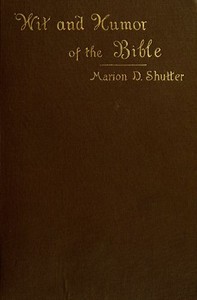
Wit and Humor of the Bible: A Literary Study — Reading Notes
(0 User reviews)
1251
Project Gutenberg
2012
Not confirmed
Bible as literature
Readers of public-domain and historical texts
Project Gutenberg digital edition
en
Edition facts
Words
40,506
Reading time
177 min
Text sections
5
For Wit and Humor of the Bible: A Literary Study — Reading Notes, the stored edition analysis reports 40,506 words, 2 hr 57 min estimated reading time, and 5 detected text sections.
The text analysis averages about 21.0 words per sentence, while the detected sections provide another way to judge how the source is divided.
Project Gutenberg metadata also associates the work with “Bible as literature,” connecting these edition facts with the source record’s subject description.
Source:
Project Gutenberg record #39546
Marion D. Shutter's 1893 study argues that biblical writers employed wit and humor as deliberate literary devices, analyzing proverbs, parables, and epistles through a lens of verbal irony, satire, and wordplay, while defending the topic against charges of irreverence.
Read the complete public-domain text at its original source.
Read on Project GutenbergMarion D. Shutter opens his 1893 study by anticipating outrage: the very title, he admits, will strike some as “flat blasphemy.” He immediately disclaims irreverence, positioning his work not as a jest-book but as a literary investigation into a neglected side of sacred literature. The preface notes that an earlier article on the subject was listed in Poole’s Index as the only one extant—a claim that underscores the novelty of his approach. Shutter draws on epigraphs from Shorthouse and Kirke to frame humor as integral to depicting human life, even citing St. Paul’s pun in Galatians 5:12 as “high authority for jesting.” The result is a careful, scholarly argument that wit in the Bible is neither accidental nor profane, but a deliberate rhetorical strategy.
Proverbial Wit: The Fool, the Sluggard, and the Babbler
Shutter devotes considerable attention to the Book of Proverbs, where he identifies three recurring comic targets: the fool, the sluggard, and the babbler. He notes that the proverbialists’ contempt for the self-conceited fool rivals Dr. Johnson’s famous retort, “Madam, I am not fond of meeting fools anywhere.” The sluggard is castigated with a series of sharp epigrams: “As the door turneth upon its hinges, so doth the slothful upon his bed,” and the ultimate absurdity, “The slothful hideth his hand in his bosom; it grieveth him to bring it again to his mouth.” Shutter calls this “the very acme of indolence.” The babbler is handled with pithy maxims on silence, such as “Even a fool when he holdeth his peace is accounted wise.” Shutter compares this to Shakespeare’s Merchant of Venice, but notes that the proverb’s condensation gives it an edge. He also brings in the Epistle of James, whose passage on the tongue—“a little member and boasteth great things”—he sets beside Æsop’s fables, showing how biblical wit operates through vivid, compressed imagery.
The Pun as Argument: Paul’s Verbal Play
Shutter highlights St. Paul’s use of wordplay, particularly the pun in Galatians 5:12, which he calls “a humorous pun” in the original Greek. This example serves as a key piece of evidence that humor is not absent from the New Testament. Shutter does not elaborate on the exact wording, but he uses it to counter the assumption that sacred texts must be uniformly solemn. He also references Paul’s rhetorical strategies more broadly, suggesting that the apostle’s irony and sarcasm—such as his taunt in 2 Corinthians 11:19, “Ye suffer fools gladly, seeing ye yourselves are wise”—function as a form of wit that underscores his arguments. Shutter’s treatment is careful: he does not claim that Paul is joking lightly, but that his verbal dexterity is a literary tool for persuasion. This section underscores the book’s central thesis: that humor in the Bible is not a flaw but a feature of its literary artistry.
Defending the Enterprise: Shutter’s Apologetic Frame
Throughout the introductory material, Shutter is acutely aware of potential criticism. He anticipates the charge that he is “a flippant rogue” undermining biblical authority, and he responds by framing his study as a serious literary analysis. He notes that “many have taken in hand to set forth in order” the pathos and sublimity of the Bible, but the comic elements have been “rarely mentioned.” His own investigation began with an article, later expanded into lectures at Lombard University, and finally into this volume. He explicitly disclaims completeness: “It would be presumptuous to claim that these few pages exhaust the subject.” This modesty is strategic, allowing him to open a field without overreaching. The dedication to his wife, Mary Wilkinson Shutter, and the copyright date of 1892, ground the work in a specific historical moment—the late nineteenth-century interest in the Bible as literature, a movement that sought to apply secular critical methods to sacred texts.
Shutter’s study is best approached as a pioneering work in biblical literary criticism, not a theological treatise. Readers should attend to his method: he moves from specific textual examples—a proverb, a pun, a parable—to broader claims about genre and intent. The excerpts provided do not reveal his treatment of narrative humor (e.g., in the Book of Jonah or Elijah’s taunts), so the full scope of his argument remains incomplete. Yet the core insight—that wit in the Bible is a deliberate, artful device—is clearly established. For those interested in the intersection of humor and religion, this book offers a rare, historically grounded perspective.
I found myself smiling at Shutter’s insistence that laughter lives inside scripture, not as noise, but as a quiet, knowing wink. That thought lingered, and I drifted to my old copy of Thoughts on Religion — Reading Companion, where the margins hold my own pencil marks from years past. Some books feel like conversations we keep having with ourselves.
There are no reviews for this eBook.
There are no comments for this eBook.
Reader reflection
Record your reading impressions
A brief reflection can help important ideas stay with you longer.
Your progress
0
/
10
2
Was reading this book enjoyable?
3
Would you recommend this book to another reader?
4
How demanding did the text feel?
5
How did the pace of the book feel?
6
Which element worked best for you?
7
How original did the book feel?
8
What was its emotional impact?
9
What is the main idea you are taking away?
10