1

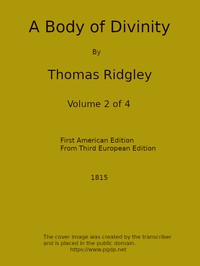
A Body of Divinity, Vol. 2 (of 4) Wherein the doctrines of the Christian religion are explained and defended, being the substance of several lectures on the Assembly's Larger — Reading Notes
(0 User reviews)
577
Project Gutenberg
2020
Not confirmed
Theology, Doctrinal; Presbyterianism; Westminster Assembly (1643-1652). Larger catechism; Presbyterian Church -- Doctrines
Readers of public-domain and historical texts
Project Gutenberg digital edition
en
Edition facts
Words
307,112
Reading time
1336 min
Text sections
43
A Body of Divinity, Vol. 2 (of 4) Wherein the doctrines of the Christian religion are explained and defended, being the substance of several lectures on the Assembly's Larger — Reading Notes can be approached with a clearer sense of reading commitment from its source measurements: 307,112 words, 22 hr 16 min estimated reading time, and 43 detected text sections.
The text analysis averages about 41.0 words per sentence, while the detected sections provide another way to judge how the source is divided.
Project Gutenberg metadata also associates the work with “Theology, Doctrinal,” connecting these edition facts with the source record’s subject description.
Source:
Project Gutenberg record #62149
This volume of Thomas Ridgley's lectures on the Westminster Assembly's Larger Catechism examines creation, angels, providence, the fall, and the covenant of grace, using a question-and-answer structure that moves from doctrinal definition to scriptural defense and practical application.
Read the complete public-domain text at its original source.
Read on Project GutenbergThomas Ridgley's A Body of Divinity, Vol. 2 proceeds by numbered questions drawn from the Westminster Assembly's Larger Catechism, each answered with a lecture that first defines terms, then marshals scriptural proofs, and finally draws practical inferences. The work's structure is itself a theological argument: the sequence from creation (Question XIV) through providence, the fall, and the covenant of grace mirrors the catechism's own narrative of redemption. Ridgley's method is cumulative; earlier discussions of God's work in creation and providence provide the foundation for later treatments of human sin and Christ's mediation.
The Architecture of Doctrinal Exposition
Ridgley organizes each lecture around a three-part movement: explanation of the catechism answer, scriptural confirmation, and application. For example, in treating creation (Question XIV), he first defines the term, then argues that the world was not eternal, citing the invention of arts and the testimony of Moses, and finally considers the six days as a display of divine power and glory. This pattern recurs throughout the volume, giving the reader a predictable rhythm that aids comprehension. The annotations by James P. Wilson, often in footnotes, add cross-references and occasional clarifications, but the main text remains Ridgley's lecture voice—measured, logical, and homiletic.
Recurring Images: The Crown and the Cross
A striking image appears in the discussion of Christ's kingly office: Christ presents to his subjects 'the crown of life' with one hand and 'the cross' with the other. This dual imagery recurs in various forms throughout the volume, emphasizing that Christian obedience involves both promise and suffering. Ridgley returns to the metaphor of the Israelites longing for Egypt's 'onions and garlic' to warn against spiritual apostasy, and he repeatedly invokes the figure of Lot fleeing Sodom, 'not so much as to look back.' These biblical types function as recurring visual anchors, reinforcing the theme of perseverance under trial.
Movement Between Scenes: From Eden to the Covenant
The volume's structure traces a deliberate movement from the garden of Eden (Question XX, 'Of God's providence towards man in innocency') to the fall and its consequences, and then to the covenant of grace. Ridgley treats Paradise not as a static idyll but as a scene of probation, where Adam's 'secular employment' and dominion over creatures are part of a covenantal arrangement. The transition from innocence to sin is marked by a shift in rhetorical tone: earlier sections are more expository, while later ones become increasingly hortatory, urging readers to 'flee from the wrath to come' and to 'hold fast the profession of their faith without wavering.'
The Role of Scriptural Citation in Ridgley's Argument
Ridgley's argumentative method relies heavily on the accumulation of scriptural references, often citing multiple passages in a single paragraph. For instance, in discussing the duties of Christ's subjects, he strings together Hebrews 6:12, Romans 12:11, John 6:60, Matthew 10:22, and Luke 14:26 within a few sentences. This technique creates a dense web of biblical authority, but it also means that the reader must follow the thread of Ridgley's reasoning through a thicket of citations. The effect is cumulative rather than analytical; Ridgley assumes the reader's familiarity with the texts and uses them as building blocks for doctrinal construction.
Readers approaching this volume will benefit from attending to the interplay between the catechism's numbered questions and Ridgley's expansive lectures. The work rewards slow reading, as each section builds on the previous one. Wilson's annotations, while not extensive, occasionally clarify points of controversy or provide additional references. For those interested in eighteenth-century Reformed theology, this volume offers a window into how the Larger Catechism was taught and applied in a pastoral context.
That rainy afternoon, Ridgley’s careful defenses of providence felt less like doctrine and more like a hand steadying my own wandering thoughts. His question-and-answer rhythm was a kind of calm. When I finally set it down, the quiet weight of it lingered, and I reached for The Bible for Young People — Inside the Classic almost without deciding. It softened the same truths into stories, which felt exactly right.
There are no reviews for this eBook.
There are no comments for this eBook.
Reader reflection
Before you leave, reflect on the book
Use these questions to collect your thoughts before moving on.
Your progress
0
/
10
2
Did this book hold your interest?
3
Is this a title you would suggest to others?
4
How demanding did the text feel?
5
Did this book create an emotional response?
6
How did the reading compare with what you expected?
7
Did it raise ideas you would like to talk about?
8
Did the story or argument move comfortably?
9
In one sentence, what did you learn?
10