1

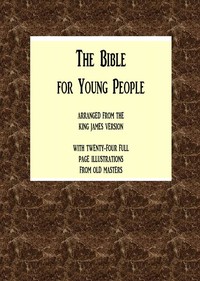
The Bible for Young People — Inside the Classic
(0 User reviews)
325
Project Gutenberg
2014
Not confirmed
Bible stories, English
Readers of public-domain and historical texts
Project Gutenberg digital edition
en
Edition facts
Words
260,814
Reading time
1134 min
Text sections
32
The Bible for Young People — Inside the Classic can be approached with a clearer sense of reading commitment from its source measurements: 260,814 words, 18 hr 54 min estimated reading time, and 32 detected text sections.
The text analysis averages about 25.1 words per sentence, while the detected sections provide another way to judge how the source is divided.
Project Gutenberg metadata also associates the work with “Bible stories, English,” connecting these edition facts with the source record’s subject description.
Source:
Project Gutenberg record #45195
Gwendolen Jackson Gilder's 1902 compilation retells Bible stories using the King James Version, omitting genealogies and doctrines. The text is reorganized into continuous narratives with new chapter divisions, preserving original wording while adapting for young readers.
Read the complete public-domain text at its original source.
Read on Project GutenbergGwendolen Jackson Gilder's The Bible for Young People (1902) re-presents the King James Version by excising genealogies, doctrines, and material deemed unsuitable for children, while retaining the original wording and spelling. The compiler introduces a wholly new system of chapters and verse divisions, grouping episodes into continuous narratives—such as a unified life of Jesus drawn from all four Gospels. The table of contents lists each story by subject, enabling direct access to specific episodes. This structural overhaul, paired with twenty-four full-page reproductions of Old Master paintings, frames the biblical text as a collection of discrete, morally instructive tales rather than a continuous scripture.
Selective Continuity
The compiler's method is visible in the table of contents, where episodes are grouped under headings like “The Beginnings” and “Abraham and Isaac,” each subdivided into titled chapters such as “The Creation of the World” and “The Call of Abram.” This arrangement breaks the biblical books into self-contained stories, omitting intervening legal codes, prophecies, and genealogical lists. The result is a streamlined narrative that moves from creation to the kings of Israel without the interruptions of Levitical law or prophetic oracles. The excerpts show that the text retains the King James phrasing—“And the anger of the Lord was kindled against Israel”—but the surrounding context is pruned to focus on action and consequence. Readers encounter a sequence of dramatic events rather than a complex theological document.
Moral Framing in Action
The editorial lens of moral suitability is evident in the selection of episodes. The story of Elisha's death (2 Kings 13) is included, complete with the prophet's anger at the king for striking the ground only three times instead of five or six—a moment that underscores the importance of complete obedience. The account of Amaziah (2 Kings 14) explicitly quotes the law of Moses: “The fathers shall not be put to death for the children, nor the children be put to death for the fathers; but every man shall be put to death for his own sin.” This legal principle is retained, while surrounding political details are condensed. Such choices emphasize individual moral responsibility and divine reward or punishment, aligning with the publisher's stated aim of providing what is “most suited to the minds of girls and boys.”
Language and Rhythm
The excerpts preserve the characteristic cadence of the King James Version, with its parallel clauses and formulaic transitions (“And it came to pass,” “And he did that which was evil in the sight of the Lord”). However, the removal of verse numbers and the introduction of new chapter breaks alter the reading experience. Without verse markers, the prose flows as continuous paragraphs, and the new chapter headings—such as “Death of Elisha” or “Joash and Amaziah”—function as titles for self-contained units. The language remains archaic (“thou shalt smite the Syrians”), but the structure invites a narrative, almost novelistic engagement. The compiler does not modernize the wording, but the reorganization makes the text more accessible to a young audience unfamiliar with traditional chapter and verse divisions.
Readers approaching The Bible for Young People should note that it is not a complete Bible but a curated selection, shaped by early twentieth-century assumptions about childhood and morality. The absence of genealogies and doctrines means that the text foregrounds story over theology. Comparing the table of contents with a standard Bible reveals which episodes were considered essential and which were omitted. The inclusion of Old Master illustrations further signals an aesthetic, as well as a religious, purpose. This edition offers a window into how biblical narratives were packaged for a young audience at the turn of the century.
I remember my grandmother’s old Sunday-school Bible, its thin pages worn at the corners, and how the stories felt less like lessons and more like family history. Reading Gilder’s retelling, I felt that hush again. It reminded me of sitting with Religion and Science from Galileo to Bergson — Story, Setting & Ideas last autumn, the same gentle realization that big questions are just stories we’re still telling ourselves at dusk.
There are no reviews for this eBook.
There are no comments for this eBook.
Reader reflection
Before you leave, reflect on the book
Use these questions to collect your thoughts before moving on.
Your progress
0
/
10
2
Was reading this book enjoyable?
3
Would you encourage someone else to read it?
4
How demanding did the text feel?
5
How original did the book feel?
6
What did you appreciate most?
7
How personally connected did you feel to the book?
8
Did you gain anything practical from the text?
9
What is the main idea you are taking away?
10