1

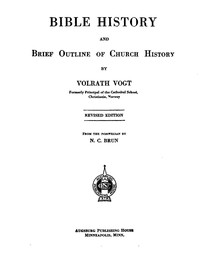
Bible history and brief outline of church history — Inside the Classic
(0 User reviews)
483
Project Gutenberg
2023
Not confirmed
Church history; Bible -- History of Biblical events
Readers of public-domain and historical texts
Project Gutenberg digital edition
en
Edition facts
Words
38,668
Reading time
169 min
Text sections
12
This digital edition of Bible history and brief outline of church history — Inside the Classic is described by source-level measurements including 38,668 words, 2 hr 49 min estimated reading time, and 12 detected text sections.
The text analysis averages about 18.1 words per sentence, while the detected sections provide another way to judge how the source is divided.
Project Gutenberg metadata also associates the work with “Church history,” connecting these edition facts with the source record’s subject description.
Source:
Project Gutenberg record #71231
This editorial note examines the authorial choices in Volrath Vogt's Bible history, focusing on concise narrative voice, direct dialogue, and structural clarity in retelling biblical events.
Read the complete public-domain text at its original source.
Read on Project GutenbergVolrath Vogt's Bible History and Brief Outline of Church History, translated by N. C. Brun, presents biblical narratives in a notably compressed style. The text condenses episodes like the woman at the well into a few paragraphs, prioritizing direct dialogue and swift resolution over descriptive expansion. For instance, Jesus' exchange with the Samaritan woman moves quickly from request to revelation: 'I am Messiah.' This economy of language shapes the reader's experience, emphasizing doctrinal points through succinct exchanges rather than narrative embellishment.
Dialogue as a Vehicle for Doctrine
The excerpts reveal a consistent pattern: dialogue carries the theological weight. In the account of Jesus and Nicodemus, the conversation is reduced to the essential exchange about being born again and the lifting up of the Son of Man. The woman at the well similarly moves from practical confusion—'Sir, Thou hast nothing to draw with, and the well is deep'—to theological recognition. Vogt uses the woman's questions about worship locations to pivot to Jesus' declaration that 'God is a Spirit, and they that worship Him must worship in spirit and truth.' The dialogue is not naturalistic but functional, each line advancing a key teaching.
Narrative Compression and Selection
Vogt's method is evident in the parable of the sower: the telling is brief, followed immediately by Jesus' explanation. The text does not dwell on imagery or setting but moves straight to interpretation. Similarly, the parable of the tares is given in a few sentences, with the explanation appended. This structure suggests a pedagogical aim—the narratives are tools for conveying meaning, not for literary immersion. The selection of episodes also reflects this: the 50 Old Testament and 50 New Testament sections cover major events but omit many details found in the source texts.
The Translator's Role in Shaping Voice
N. C. Brun's translation from the Norwegian retains a formal, slightly archaic English register. Phrases like 'straightway they sprang up' and 'thou saidst well' echo the King James Version, lending a scriptural tone. However, the syntax is often simpler: 'Jesus said: I am Messiah.' The translator's choices—such as using 'Savior of the world' rather than a more literal rendering—align the text with familiar Protestant terminology. The result is a voice that feels both authoritative and accessible, suitable for instructional use.
Structural Clarity Through Headings and Lists
The table of contents reveals a deliberate organization: each event is a discrete numbered section, from 'Creation' to 'The Books of the Old Testament.' Within the New Testament, parables and miracles are grouped under subheadings. This structure aids reference but also shapes reading as a series of self-contained lessons. The text does not provide transitions or narrative flow between sections; instead, it presents each episode as a standalone unit. This approach reflects the book's likely use in educational settings, where clarity and memorability are prioritized over continuous storytelling.
Readers approaching this work should expect a condensed, doctrine-focused retelling rather than a literary or historical expansion. The brevity of each section invites slow reading and reflection on the theological points embedded in dialogue and explanation. Comparing these summaries with the full biblical accounts may reveal Vogt's interpretive choices—what he includes, omits, and emphasizes—offering insight into early twentieth-century Norwegian Lutheran pedagogy.
There’s a quiet comfort in Vogt’s plain-spoken retelling, how he lets the dialogue carry the weight without fuss. It reminds me of an old habit—sitting with The Cradle of the Christ: A Study in Primitive Christianity — Reading Notes, where the early church feels less like history and more like a memory I almost recognize. Odd, that. The older I get, the more that plainness feels like home.
There are no reviews for this eBook.
There are no comments for this eBook.
Reader reflection
Take a moment to reflect on this book
Create a short personal record of your experience with this book.
Your progress
0
/
10
2
What was your overall reaction to the book?
3
Would you recommend this book to another reader?
4
How demanding did the text feel?
5
Which part made the strongest impression?
6
Did any part of the book feel personally relevant?
7
Did you gain anything practical from the text?
8
Did this book create an emotional response?
9
Which lesson or insight stayed with you?
10