1

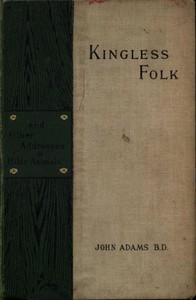
Kingless Folk, and Other Addresses on Bible Animals — Text and Context
(0 User reviews)
162
Project Gutenberg
2015
Not confirmed
Animals in the Bible; Nature in the Bible
Readers of public-domain and historical texts
Project Gutenberg digital edition
en
Edition facts
Words
26,626
Reading time
116 min
Text sections
5
This digital edition of Kingless Folk, and Other Addresses on Bible Animals — Text and Context is described by source-level measurements including 26,626 words, 1 hr 56 min estimated reading time, and 5 detected text sections.
The text analysis averages about 19.9 words per sentence, while the detected sections provide another way to judge how the source is divided.
Project Gutenberg metadata also associates the work with “Animals in the Bible,” connecting these edition facts with the source record’s subject description.
Source:
Project Gutenberg record #48399
John Adams examines Bible animals through natural history and moral analogy, using the ant, pearl-oyster, and fly to illustrate lessons on work, value, and kindness. The addresses blend scripture, proverbs, and scientific observation without claiming completeness.
Read the complete public-domain text at its original source.
Read on Project GutenbergJohn Adams opens his address on the ant by quoting Proverbs and immediately asking, "Of what use is a sluggard?" He answers with a cascade of proverbs and a rhyming chain about a lost kingdom, then sends the sluggard back to school with the ant as teacher. The ant teaches three kinds of wisdom: work, providence, and—though the excerpt breaks off—presumably more. Adams does not simply moralize; he notes that ant colonies contain "workers" and a few winged males and females, grounding his lesson in observed natural roles.
Pearls as Accidents and Allegories
In the chapter on the pearl-oyster, Adams begins with Matthew 7:6—"Neither cast ye your pearls before swine"—and immediately warns against overcaution. He quotes Matthew Henry and balances the text with the golden rule, insisting that Christians must not excuse themselves from helping neighbours by labelling them dogs or swine. Then he turns to natural history: what is a pearl? He dismisses ancient fancies about dew and lightning, citing one writer who called the pearl Jesus. Science, he says, describes a pearl as "an accidental concretion of shelly matter." A grain of sand inside the shell triggers layer after layer of nacre. Adams notes that the Chinese exploit this process to make imitation pearls. The lesson is that value arises from irritation transformed—a physical process that mirrors spiritual refinement.
The Fly's Niche and the Law of Kindness
Adams devotes a chapter to the fly, a creature often despised. He argues that flies fill a vital ecological niche: without them, there would be no trout that appreciated them. The fly "neither lives a useless life nor dies a useless death." Its structure and usefulness both point to the Creator, and Adams quotes Pope: "Who sees with equal eye, as God of all, / A hero perish, or a sparrow fall." He then pivots to a moral application: if the boy is father to the man, then cruelty to a fly can escalate to cruelty toward a human heart. The law of kindness must rule in the least as well as the greatest. This is a specific, traceable argument: the fly's ecological role becomes a springboard for an ethic of compassion that begins with small creatures.
Proverbs, Rhymes, and the Texture of Argument
Adams's method is to weave scripture, folk wisdom, and natural observation into a single fabric. In the ant chapter, he strings together John Ploughman, a rhyming proverb about a nail and a kingdom, and the biblical list of four little wise things. He does not cite sources formally; he absorbs them. The effect is a homiletic style that feels oral and accumulative. He also uses contrast: the sluggard is all chaff, while the ant is all work. The pearl chapter juxtaposes ancient fancy (dew and lightning) with modern science (accidental concretion). The fly chapter moves from ecological niche to moral law. These shifts are not jarring; they are the book's method. Adams treats the Bible as a book of nature and nature as a book of morals, and his prose mirrors that double vision.
Adams's addresses are best read as standalone homilies rather than a continuous argument. Each chapter selects one animal, one biblical text, and one moral thread. The natural history is period-specific—late Victorian popular science—but the moral questions are not. Readers interested in how scripture and natural observation were woven together in the 1890s will find a clear, unpretentious example. The book does not claim to exhaust its subjects; it offers starting points for reflection.
Some evenings, after the patrons have gone, I think of Adams’s quiet ways with the ant and the fly—how he found holy patience in small, scuttling things. There is a companionable spirit in that old lecture, About The Holy Bible: A Lecture — Reading Companion, which sits nearby on my shelf like a familiar whisper, asking nothing, simply keeping the same gentle watch over words that have outlived their writers.
There are no reviews for this eBook.
There are no comments for this eBook.
Reader reflection
Take a moment to reflect on this book
Create a short personal record of your experience with this book.
Your progress
0
/
10
2
What was your overall reaction to the book?
3
Is this a title you would suggest to others?
4
How easy was the book to follow?
5
How valuable was this book for your own interests?
6
What was the strongest part of the book?
7
Did this book create an emotional response?
8
Do you expect to return to this book?
9
What is the main idea you are taking away?
10