1

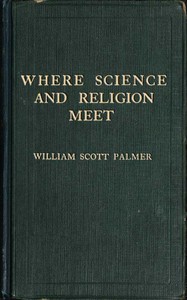
Where Science and Religion Meet — Edition Insights
(0 User reviews)
309
Project Gutenberg
2016
Not confirmed
Religion and science
Readers of public-domain and historical texts
Project Gutenberg digital edition
en
Edition facts
Words
47,921
Reading time
209 min
Text sections
25
The source record for Where Science and Religion Meet — Edition Insights measures this digital text at 47,921 words, 3 hr 29 min estimated reading time, and 25 detected text sections.
The text analysis averages about 24.4 words per sentence, while the detected sections provide another way to judge how the source is divided.
Project Gutenberg metadata also associates the work with “Religion and science,” connecting these edition facts with the source record’s subject description.
Source:
Project Gutenberg record #52245
Palmer's 1914 work argues for a sacramental view of nature, using biological and Christian language to bridge science and religion, with a distinctive authorial voice that prioritizes accessibility over scholarly apparatus.
Read the complete public-domain text at its original source.
Read on Project GutenbergWilliam Scott Palmer opens Where Science and Religion Meet with an epigraph from Émile Boutroux calling life the “trait d’union” of science and religion, then immediately signals his method by quoting Jowett on a “method of idealized experience” that connects rather than divides. The author’s note is unusually personal: he has built a “wayside cottage for travellers who are in haste,” not a museum, and deliberately omits references to keep the argument flowing. This choice—to write for the hurried reader rather than the specialist—shapes every page that follows.
A Cottage, Not a Museum
Palmer’s prefatory note is the most direct statement of his authorial strategy. He admits he has not named his authorities or given references, anticipating criticism but asking readers to judge his “cottage” on its own terms. The metaphor is deliberate: a wayside shelter offers rest and direction, not exhaustive display. He includes an appendix of “easily accessible books” but insists that particular quotations would have interfered with his purpose. This is not a work of academic citation but of synthesis, aimed at readers who want a coherent vision rather than a bibliography. The tone is courteous but firm, and it sets the expectation that Palmer will prioritize clarity over completeness.
The Sacramental Principle in Nature
Palmer’s central theological argument emerges in his discussion of the “sacramental principle.” He writes that if Jesus Christ is “the unclouded revelation of God in terms of man,” then the whole world of men and things is best interpreted through him. This leads to a striking claim about ordinary bread: consecrated bread is set apart because “what is everywhere and always soon comes to be nowhere and never for our interest.” The Christian keeps the Eucharist as a “rare thing” to preserve the principle it enshrines. Palmer calls the consecrated bread a “central symbol” and a “signum efficax”—an effective sign not merely for thought but for all human life. This is not a vague spirituality; it is a specific, sacramental ontology grounded in Christian practice.
Extending the Biologist’s Ladder
In Chapter II, Palmer directly addresses the biologist. He asserts that for the Christian, a human being is “capable of receiving and assimilating life as no other creature can,” a claim the biologist has no biological reason to accept. Yet Palmer insists that the Christian’s “ladder of spiritual reality” is a legitimate extension of the biologist’s evolutionary ladder. He asks whether any knowledge—biological, chemical, physical—can be “knowledge of some alien reality not embraced in God.” His answer is a firm no: “If God is, then all truth attained by man is truth of him.” This is not a concession to science but a redefinition of its scope: learning about the world is learning about God. Palmer maintains that the departmental separation of knowledge is merely practical, not ultimate.
Readers should note that Palmer’s argument depends on a specific Christian orthodoxy—the incarnation and the Eucharist—rather than on a generic theism. The excerpts show a writer who is comfortable with technical theological terms (“sacramental principle,” “signum efficax”) and with biological vocabulary, but who refuses to let either discipline have the last word. His tone is conversational yet precise, and his habit of posing rhetorical questions (“Is it reasonable to regard biological knowledge … as knowledge of some alien reality?”) invites the reader into the reasoning. The book is best approached as a personal essay in philosophical theology, not a systematic treatise.
Reading Palmer’s gentle blending of sacraments and science, I found myself thinking of how stories, too, carry a quiet cohesion. There’s a similar warmth in Joseph the Dreamer — Reading Companion, a book that turns ancient narrative into something personal—less analysis, more presence. Both remind me that understanding often arrives through the heart’s patient attention.
There are no reviews for this eBook.
There are no comments for this eBook.
Reader reflection
Record your reading impressions
A brief reflection can help important ideas stay with you longer.
Your progress
0
/
10
2
How much did you enjoy the reading experience?
3
Would you recommend this book to another reader?
4
How demanding did the text feel?
5
How closely did the book connect with your experience?
6
Do you expect to return to this book?
7
Which element worked best for you?
8
Could you apply anything you learned?
9
What did this book teach you most?
10