1


Faith and Duty: Sermons on Free Texts, with Reference to the Church-Year — Context and Discussion
(0 User reviews)
3436
Project Gutenberg
2015
Not confirmed
Sermons, American; Church year sermons; Lutheran Church -- Sermons
Readers of public-domain and historical texts
Project Gutenberg digital edition
en
Edition facts
Words
143,183
Reading time
623 min
Text sections
59
The source record for Faith and Duty: Sermons on Free Texts, with Reference to the Church-Year — Context and Discussion measures this digital text at 143,183 words, 10 hr 23 min estimated reading time, and 59 detected text sections.
The text analysis averages about 21.8 words per sentence, while the detected sections provide another way to judge how the source is divided.
Project Gutenberg metadata also associates the work with “Sermons, American,” connecting these edition facts with the source record’s subject description.
Source:
Project Gutenberg record #49618
This collection of 59 sermons by Rev. Louis Buchheimer follows the church year, each based on a free text. The structure moves from Advent through Trinity, with recurring images of Christ as High Priest, advocate, and forerunner, and a focus on the believer's union with Christ.
Read the complete public-domain text at its original source.
Read on Project GutenbergRev. Louis Buchheimer's Faith and Duty arranges fifty-nine sermons by the church year, from the First Sunday in Advent to Reformation Sunday, each taking a free text—a passage not prescribed by the lectionary. The collection's structure mirrors the liturgical calendar, but within that framework the sermons move through recurring images: Christ as High Priest entering the Holy of Holies, the believer's union with the ascended Head, and the Christian life as a journey toward a prepared place. Buchheimer often ties Old Testament types to New Testament fulfillment, as when he compares the Jewish high priest bearing tribal names to Christ bearing believers' names on His breast.
The Liturgical Frame and Free Texts
The sermons follow the church year from Advent to Reformation, but each is anchored to a free text rather than the day's Gospel or Epistle. For example, the First Sunday in Advent uses Genesis 7:1, while Easter draws on John 5:28–29. This choice allows Buchheimer to develop themes that complement the season without being bound to the appointed readings. The table of contents shows a deliberate pairing: Advent opens with Noah's entry into the ark, and Lent begins with Moses holding up his hands in Exodus 17. The structure thus creates a double movement—through the calendar and through a web of scriptural references that span both Testaments.
Recurring Images: High Priest, Advocate, Forerunner
A central image in the Ascension sermon is Christ as the great High Priest who, having shed His blood, enters the heavenly Holy of Holies to intercede. Buchheimer writes that He "holds up the hands that felt the nails, ever pleading in our behalf." This image recurs in the Trinity sermon's reference to 2 Corinthians 13:14 and in the emphasis on Christ as Advocate. Another repeated figure is that of the forerunner: Christ's ascension is described as "an earnest pledge of our own," and the sermon states that "His entering for us implies our entrance also." The language of the Head and members, the vine and branches, ties these images together across multiple Sundays.
Movement Between Scenes: From Earth to Heaven
Buchheimer frequently moves his listeners from a concrete biblical scene to a heavenly reality. In the Ascension sermon, he begins with the disciples on Mount Olivet watching Christ ascend, then shifts to the heavenly throne room where Christ intercedes. The same pattern appears in the Christmas sermon (2 Corinthians 9:15), which moves from the gift of the Son to the believer's response of gratitude. The sermon for the Last Sunday in the Year (Isaiah 64:6) contrasts human frailty with divine mercy. This movement is not merely illustrative; it structures the argument, grounding doctrine in narrative and then elevating it to present comfort or exhortation.
The Believer's Union with Christ
Throughout the collection, Buchheimer emphasizes the believer's identification with Christ. In the Ascension sermon, he notes that Saul's persecution of Christians is taken as persecution of Christ Himself: "Jesus thus identifies Himself with His people." This union is developed through the image of the Church as Christ's body, with the ascended Head guaranteeing the members' future ascent. The sermon for the Fifth Sunday after Easter (Ephesians 6:18) and the Pentecost sermon (Zechariah 4:6) similarly stress dependence on Christ's power. The recurring phrase "our great High Priest" and the repeated assurance that Christ "bears our names upon His breast" reinforce a pastoral tone that aims to console and strengthen faith.
Exhortation and Consolation in the Christian Life
Buchheimer's sermons consistently move from doctrinal exposition to practical application. The sermon for the Fourth Sunday after Epiphany (Matthew 14:22–27) uses the storm on the sea to encourage trust in Christ's presence. The sermon for the Twenty-third Sunday after Trinity (Mark 12:41–44) draws on the widow's mite to teach sacrificial giving. The closing paragraphs often address the listener directly, urging gratitude, hope, or perseverance. This pattern gives the collection a homiletic unity: each sermon builds a bridge from the text to the believer's daily walk, with the Ascension sermon's final note—"How the ascension of Christ confirms our faith, animates our hope!"—echoing throughout.
Readers approaching Faith and Duty will find a consistent homiletic method: each sermon begins with a free text, develops a central image or type, and applies it to the believer's life. The liturgical arrangement invites sequential reading, but individual sermons stand alone. Buchheimer's voice is pastoral and doctrinal, weaving Old Testament types with New Testament fulfillment. Those interested in early twentieth-century Lutheran preaching or the use of free texts within the church year will find this collection a focused example of that tradition.
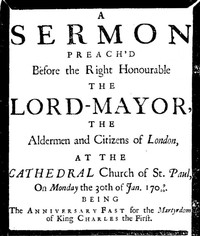
Buchheimer’s Faith and Duty always felt like patient counsel, the High Priest ever interceding. It made me quietly remember another shelf, an older voice with the same gravity—A sermon preach'd before the Right Honourable the Lord-Mayor : the aldermen and citizens of London at the Cathedral-Church of St. Paul on Monday the 30th of Jan. 1709/10 — Edition Insights—there, too, duty bound to grace, a hushed kinship across centuries.
There are no reviews for this eBook.
There are no comments for this eBook.
Reader reflection
Before you leave, reflect on the book
Use these questions to collect your thoughts before moving on.
Your progress
0
/
10
2
How much did you enjoy the reading experience?
3
Would you encourage someone else to read it?
4
Did the language feel accessible?
5
How well did it match your expectations?
6
Could you apply anything you learned?
7
How strongly did the book affect you emotionally?
8
Did you relate to its people, ideas, or situations?
9
What changed or sharpened your thinking?
10