1

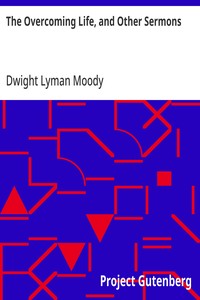
The Overcoming Life, and Other Sermons — Context and Discussion
(0 User reviews)
2254
Project Gutenberg
2010
Not confirmed
Sermons, American; Evangelistic sermons; Evangelistic work
Readers of public-domain and historical texts
Project Gutenberg digital edition
en
Edition facts
Words
38,609
Reading time
168 min
Text sections
4
Before opening The Overcoming Life, and Other Sermons — Context and Discussion, the edition data offers a quick orientation: 38,609 words, 2 hr 48 min estimated reading time, and 4 detected text sections.
The text analysis averages about 16.9 words per sentence, while the detected sections provide another way to judge how the source is divided.
Project Gutenberg metadata also associates the work with “Sermons, American,” connecting these edition facts with the source record’s subject description.
Source:
Project Gutenberg record #33015
Moody's sermons use military and building metaphors to frame Christian life as active struggle, with vivid hypotheticals about Noah's critics and warnings against relying on initial conversion alone.
Read the complete public-domain text at its original source.
Read on Project GutenbergDwight L. Moody opens The Overcoming Life, and Other Sermons with a frank correction of his own early assumption that conversion ends the battle. Instead, he likens it to enlistment: the real fight begins afterward. Drawing on 1 John 5:4–5 and 1 Corinthians 3:11–15, he distinguishes between salvation as a free gift and the reward that requires effort. The excerpts show Moody repeatedly returning to the image of a voyage—some Christians barely reaching heaven “as Lot got out of Sodom, burned out.” This practical, unsentimental tone pervades the collection, which treats faith as an active, ongoing struggle rather than a settled state.
Warfare as the Christian Default
Moody’s opening sermon establishes a military framework that governs the entire collection. He tells listeners that conversion is only “enlisting in the army,” and that a crown demands work and fighting. The metaphor is not decorative; it structures his argument. He warns that a believer may be saved “yet so as through fire,” with all works burned up. This is not a message of assurance but of vigilance. Moody draws a sharp line between the gift of salvation and the prize of reward, insisting that many will barely make it, like Lot escaping Sodom with nothing left. The sermon’s title, “The Overcoming Life,” is thus presented not as a promise but as a goal requiring sustained effort.
Noah’s Folly and the Minority Report
In a later sermon, Moody reimagines Noah’s contemporaries with striking specificity. He invents a cast of skeptics: agnostics, those who trust God’s mercy too easily, geologists who see no sign in the earth, and astronomers who read no storm in the heavens. He even imagines reporters interviewing Noah, the Associated Press sending dispatches, and excursions offering tours of the ark. The humor is pointed: Noah is called “an old crank,” and carpenters who helped build the ark may have mocked him. Moody uses this extended hypothetical to argue that being in the minority does not make one wrong. The passage is less exegesis than a satirical mirror held up to Moody’s own audience, complete with saloons and theaters that ridicule the faithful.
The Danger of Presumption and the Call to Persistence
Throughout the excerpts, Moody returns to the theme that initial belief is insufficient. He recalls his own mistake: “I thought the battle was already mine.” The sermons repeatedly warn against assuming that conversion guarantees a victorious life. Instead, Moody emphasizes ongoing effort, using the image of building on a foundation—gold, silver, costly stones versus wood, hay, stubble. The test is fire, and only what endures will bring reward. This practical emphasis aligns with the catalog subjects of evangelistic sermons and evangelistic work, but the excerpts show Moody focusing less on converting non-believers than on galvanizing those who already profess faith. His tone is direct, anecdotal, and occasionally wry, as when he notes that a drunkard does not call himself mad, but a man who enters the ark is called mad.
Readers approaching The Overcoming Life, and Other Sermons should expect not a systematic theology but a series of exhortations built on vivid scenarios and repeated contrasts—enlistment versus battle, gift versus reward, majority opinion versus divine command. Moody’s voice is colloquial and urgent, often addressing imagined objections. The sermons reward attention to his rhetorical strategies: hypothetical dialogues, extended metaphors, and pointed asides that reveal his assumptions about his audience’s complacency.
Reading Moody’s insistence that conversion is only a beginning brought back a quiet afternoon with my grandfather’s old sermons, where he’d underlined a line about grace being a door, not a room. That same ache of unfinished business lingers in Faith and Duty: Sermons on Free Texts, with Reference to the Church-Year — Context and Discussion, though there it felt more like a lantern than a spur.
There are no reviews for this eBook.
There are no comments for this eBook.
Reader reflection
Before you leave, reflect on the book
Use these questions to collect your thoughts before moving on.
Your progress
0
/
10
2
Was reading this book enjoyable?
3
Would you encourage someone else to read it?
4
How much effort did this book require?
5
How strong was your personal connection to the text?
6
How well did it match your expectations?
7
Would you read this book again?
8
Did you gain anything practical from the text?
9
Which lesson or insight stayed with you?
10