1

Five Minute Sermons, Volume II. For Low Masses on All Sundays of the Year by Priests of the Congregation of St. Paul — Key Ideas to Explore
(0 User reviews)
375
Project Gutenberg
2019
Not confirmed
Catholic Church -- Sermons; Sermons, American -- 19th century
Readers of public-domain and historical texts
Project Gutenberg digital edition
en
Edition facts
Words
143,015
Reading time
622 min
Text sections
18
For Five Minute Sermons, Volume II. For Low Masses on All Sundays of the Year by Priests of the Congregation of St. Paul — Key Ideas to Explore, the stored edition analysis reports 143,015 words, 10 hr 22 min estimated reading time, and 18 detected text sections.
The text analysis averages about 22.9 words per sentence, while the detected sections provide another way to judge how the source is divided.
Project Gutenberg metadata also associates the work with “Catholic Church -- Sermons,” connecting these edition facts with the source record’s subject description.
Source:
Project Gutenberg record #60267
This volume collects 19th-century sermons by Paulist priests, designed for five-minute delivery at Low Mass. The sermons blend doctrinal instruction with moral exhortation, emphasizing prayer, perseverance, and Christian witness. The preface notes they were preached at St. Paul the Apostle, New York, and published in the Catholic Review.
Read the complete public-domain text at its original source.
Read on Project GutenbergThese sermons, preached at the Church of St. Paul the Apostle in New York and published weekly in the Catholic Review, were shaped by a specific constraint: each had to fit within the brief span of a Low Mass. The preface to this second volume acknowledges that while many manuals offer purely doctrinal instruction, these pieces aim to “edify, to quicken the moral perceptions, and to move in a reasonable degree the religious emotions.” The result is a collection that balances plain doctrine with pointed application, often addressing practical failings—fair-weather faith, bad company, profanity—rather than abstract theology.
The sermons share a direct, conversational tone. They frequently open with a question or a blunt statement, then move through a short scriptural citation, a concrete example, and a closing exhortation. The structure is economical, as the five-minute limit demands. Yet within that brevity, the preachers find room for vivid metaphors: the devil’s “laughing-stock,” the Christian on a “witness-stand,” the soul in danger of falling “as you have fallen before.”
The Rhetoric of Urgency
The sermons repeatedly create a sense of immediate spiritual danger. In one, the preacher asks why God’s help does not come, then answers by quoting the day’s Mass: “He shall call on me, and I will hear him.” The logic is stark: if you do not pray, you will not persevere. The warning is phrased as blunt fact: “The great majority of those who have been leading a bad life … will not persevere unless they are willing to take the trouble to make frequent and earnest prayers.” This is not speculation but “the teaching of experience.”
The urgency is reinforced by direct address. The preacher calls his hearers “my friends,” then presses them: “Are you, my friends, willing to take that trouble for your soul’s sake, or do you prefer to fall as you have fallen before?” The choice is binary, the stakes eternal. Such passages reveal a homiletic strategy that relies less on elaborate argument than on repeated, pointed questions designed to provoke self-examination.
Witness and the World’s Gaze
A recurring theme is the Christian’s role as a witness before a skeptical world. One sermon, taking its text from John 15:27, develops the metaphor of a courtroom: “We Christians are all on the witness-stand of this great world.” The world judges our testimony, but Christ will ultimately judge it. The preacher insists that the most effective witness is not preaching but “leading truly Christian lives,” citing the early Christians who “brought the light of faith to thousands … by the holiness of their lives.”
The sermon then turns critical: “I fear, brethren, the conduct of bad and negligent Catholics has kept back man [sic].” The incomplete sentence hints at a larger complaint—that scandal has hindered the faith. The preacher singles out those who have had faith “from the beginning”—from childhood—as having a special obligation. This focus on lifelong Catholics suggests the sermons were aimed at a settled, urban congregation, not a mission field.
Practical Piety and the Sacraments
The sermons consistently direct hearers to concrete devotional practices. Prayer is presented as the non-negotiable means of perseverance: “If we want God to deliver us, we must ask him to do it.” The preacher specifies morning prayers and frequent confession, even naming a timeline: “to come to confession again within a month.” This practical advice is embedded in a larger framework of sacramental piety, but the sermons rarely dwell on sacramental theology; instead, they treat confession and communion as tools for moral reform.
The preface itself signals this emphasis: the sermons are meant to be “skeletons for discourses of greater length,” adaptable by other preachers. This suggests a dual audience—laity hearing the five-minute version, and clergy who might expand the material. The volume thus functions as both a devotional aid and a homiletic resource, its brevity a deliberate response to the constraints of the Low Mass liturgy.
Readers approaching this volume should note its dual character: it is at once a record of late-19th-century Catholic preaching in urban America and a practical manual for clergy. The sermons’ brevity is not a limitation but a design feature, forcing each to a single, sharp point. The recurring emphasis on prayer, perseverance, and public witness reflects the concerns of a church navigating a pluralistic society. Those interested in homiletic structure, the history of Catholic devotional life, or the rhetoric of moral exhortation will find these pages a compact, revealing source.
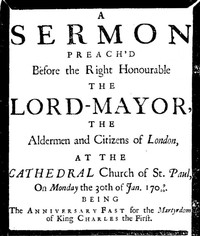
Sunday afternoons in my grandmother’s house had a certain hush, and I remember her old prayer book with its thin pages. These five-minute sermons carry that same quiet urgency, a faith packed into brief moments. It reminded me of that old A sermon preach'd before the Right Honourable the Lord-Mayor : the aldermen and citizens of London at the Cathedral-Church of St. Paul on Monday the 30th of Jan. 1709/10 — Edition Insights, another voice speaking to a city’s conscience, both reaching for something lasting.
There are no reviews for this eBook.
There are no comments for this eBook.
Reader reflection
Record your reading impressions
A brief reflection can help important ideas stay with you longer.
Your progress
0
/
10
2
Was reading this book enjoyable?
3
How likely are you to recommend this book?
4
What was the reading difficulty like?
5
Did the book give you something worth debating?
6
How well did it match your expectations?
7
How understandable was the text?
8
Which element worked best for you?
9
Which lesson or insight stayed with you?
10