1

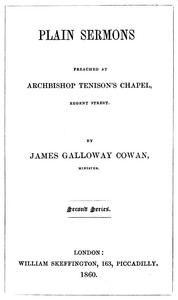
Plain Sermons, preached at Archbishop Tenison's Chapel, Regent Street. Second Series — Themes and Context
(0 User reviews)
1131
Project Gutenberg
2021
Not confirmed
Sermons, English; Church of England -- Sermons -- 19th century
Readers of public-domain and historical texts
Project Gutenberg digital edition
en
Edition facts
Words
74,222
Reading time
323 min
Text sections
7
The source record for Plain Sermons, preached at Archbishop Tenison's Chapel, Regent Street. Second Series — Themes and Context measures this digital text at 74,222 words, 5 hr 23 min estimated reading time, and 7 detected text sections.
The text analysis averages about 29.0 words per sentence, while the detected sections provide another way to judge how the source is divided.
Project Gutenberg metadata also associates the work with “Sermons, English,” connecting these edition facts with the source record’s subject description.
Source:
Project Gutenberg record #67036
Cowan's second series of plain sermons, preached at a London chapel in the 1850s, uses close scriptural analysis to reveal spiritual conflicts and moral lessons, with a focus on divine dependence and human frailty.
Read the complete public-domain text at its original source.
Read on Project GutenbergJames Galloway Cowan's Plain Sermons, preached at Archbishop Tenison's Chapel, Regent Street. Second Series (1860) offers a collection of eighteen sermons that consistently treat biblical passages as sites of spiritual contention. In the excerpt from Sermon XI on the stilling of the storm, Cowan argues that the miracle reveals a direct confrontation between Christ and Satan, not merely a calming of nature. He insists that rebuke would be meaningless if addressed to mere wind and wave, and that the episode demonstrates Satan's ongoing assault on the Saviour. This interpretive move—reading natural events as spiritual warfare—characterizes Cowan's method throughout the volume.
Spiritual Conflict as Interpretive Lens
Cowan repeatedly frames biblical narratives as contests between divine and demonic forces. In the storm sermon, he asserts that the wind and waves were agents of Satan, who sought to wreck the vessel and overwhelm Christ. He draws a parallel to Job's experience, where Satan was allowed power over the elements. This lens transforms the miracle into a victory over evil, not just a display of authority. Cowan's language is vivid: Satan 'lashed the waves into utmost fury,' and Christ's command 'Peace be still' constitutes a 'signal defeat.' The preacher does not limit this reading to the storm; he suggests that Christ's rebukes throughout the Gospels are always directed at the devil or his works, never at God or mere nature. This consistent hermeneutic gives the sermons a dramatic, almost apocalyptic tone, emphasizing the stakes of everyday faith.
The Sermon as Acted Parable
Cowan explicitly describes Christ's miracles as 'acted parables—types of spiritual things—rather outward signs, not themselves to be given up, but thereafter to be accompanied by inward grace.' This statement, found in the storm sermon, reveals his homiletic strategy: each miracle or event is a figure for the Christian life. The ship on the Sea of Galilee represents the Church or the individual believer; the sea represents the world; the storm represents trials. Cowan extends this typological reading to other sermons. In Sermon I on 'Dependence upon God,' he likely treats the Philippians passage as a pattern for trusting divine providence. The sermon titles themselves—'Judgment Here and Hereafter,' 'The Worldling Reproved,' 'Working for God'—suggest a consistent effort to apply scripture to moral and spiritual formation. The preacher's goal is not historical explanation but existential application.
Recurring Themes of Human Frailty and Divine Mercy
Across the excerpts, Cowan emphasizes human weakness and the need for divine assistance. In the storm sermon, the disciples' fear is contrasted with Christ's calm authority; they are 'of little faith.' The sermon on 'Past Mercies Reviewed' (New Year's Eve) takes Jacob's words—'I am not worthy of the least of all the mercies'—as a model for gratitude. Cowan's preaching consistently returns to the insufficiency of human effort and the sufficiency of God's grace. He warns against worldly confidence in 'The Worldling Reproved,' where the text from James condemns those who plan to 'buy and sell, and get gain' without acknowledging the Lord's will. The sermons thus form a coherent pastoral message: life is fragile, judgment is real, and only faith in Christ provides security. Cowan's plain style—direct, unadorned, and focused on application—reinforces this message without rhetorical flourish.
Readers approaching this second series will find a preacher who takes scripture seriously as a record of spiritual warfare and divine pedagogy. Cowan's sermons reward attention to his interpretive moves—how he reads storms as satanic attacks, miracles as parables, and biblical figures as types. The volume is best read slowly, one sermon at a time, allowing the cumulative weight of its pastoral concerns to emerge. Those interested in Victorian homiletics or the theological undercurrents of the Broad Church movement will find here a representative voice, earnest and unpretentious.
Cowan’s sermons have a way of making you feel the weight of your own frailty without ever feeling crushed by it. That quiet, honest struggle—the need to lean on something steadier than ourselves—is what lingers. It’s the same sober note struck in the old A sermon preach'd before the Right Honourable the Lord-Mayor : the aldermen and citizens of London at the Cathedral-Church of St. Paul on Monday the 30th of Jan. 1709/10 — Edition Insights, a century earlier, yet the same human pulse.
There are no reviews for this eBook.
There are no comments for this eBook.
Reader reflection
What was your reading experience?
Capture what you thought, learned, and would like to remember.
Your progress
0
/
10
2
Did this book hold your interest?
3
How likely are you to recommend this book?
4
How demanding did the text feel?
5
How strong was your personal connection to the text?
6
Would a second reading be valuable?
7
Was the book easy to understand?
8
Which part made the strongest impression?
9
What did this book teach you most?
10