1


Sermons Preached at the Church of St. Paul the Apostle, New York, During the Year 1861. — Edition Insights
(0 User reviews)
477
Project Gutenberg
2019
Not confirmed
Catholic Church -- Sermons; Sermons, American -- 19th century
Readers of public-domain and historical texts
Project Gutenberg digital edition
en
Edition facts
Words
71,915
Reading time
313 min
Text sections
9
Sermons Preached at the Church of St. Paul the Apostle, New York, During the Year 1861. — Edition Insights can be approached with a clearer sense of reading commitment from its source measurements: 71,915 words, 5 hr 13 min estimated reading time, and 9 detected text sections.
The text analysis averages about 19.1 words per sentence, while the detected sections provide another way to judge how the source is divided.
Project Gutenberg metadata also associates the work with “Catholic Church -- Sermons,” connecting these edition facts with the source record’s subject description.
Source:
Project Gutenberg record #59041
Twenty sermons from 1861 by the Paulist Fathers in New York, emphasizing earnest faith, moral duty, and the transformation of adversity into spiritual merit through plain, direct preaching.
Read the complete public-domain text at its original source.
Read on Project GutenbergThe Paulist Fathers' 1861 sermons open with a striking self-awareness: the preface admits these are not 'brilliant passages of imagination, flowers of style, or appeals to popular enthusiasm,' but rather 'plain, simple, and direct' addresses aimed at 'some clearer view of Christian doctrine or moral duty.' This deliberate plainness shapes every sermon. The first, 'The Earnest Man,' models the collection's method: it builds from a single epistle passage (Galatians 1:11-23) into a sustained portrait of single-minded devotion, using St. Paul as the archetype. The preacher repeatedly contrasts the 'fool who changes like the moon' with the holy man 'who continues in wisdom like the sun'—a binary that recurs across the volume.
The Earnest Man as a Template
The opening sermon establishes a pattern visible throughout the collection. It defines earnestness not as emotional intensity but as unwavering purpose: 'the earnest man' is one who 'has but one end in view—eternal life, and only one means to attain to it, namely, to do the will of God.' This definition recurs in later sermons under different names—'the just man,' 'the true Christian,' 'the saint.' The preacher uses St. Paul's conversion as evidence that even a dramatic reversal can serve a single aim. Notably, the sermon avoids narrative biography; instead, it extracts principles from Paul's letters, treating the apostle as a case study in spiritual consistency. The language is concrete: 'like the stormy petrel, they gather most in stormy weather.' Such imagery is rare; most of the volume prefers declarative statements and scriptural citation.
Adversity as a Weapon
A central tension in these sermons is the treatment of hardship. The preacher insists that 'all things work together for good to them that love God' (Romans 8:28) and develops this into a martial metaphor: adversity and prosperity are 'arms of justice, on the right hand and on the left.' The Christian is to use both 'glory and good reputation' as well as 'disgrace and evil report' as weapons. This is not passive resignation but active transformation. The sermon 'The Afflictions of the Just' likely expands this theme, though the excerpts show only the preface's hint. The preacher warns against being 'like wax, which takes any form that may be impressed upon it'—a striking image of passivity to be avoided. Instead, the Christian must remain 'unchanged in all the vicissitudes of life,' a stability that the sermons repeatedly tie to love of God.
Structure and Audience
The volume's structure reveals its intended use. Each sermon is tied to a specific occasion or commemoration—St. Paul's feast, Epiphany, Easter—yet the content is doctrinal rather than liturgical. The preface notes that these were heard 'living and warm from the preacher's lips' and are now 'cold and uncolored on the paper,' acknowledging the gap between spoken and written word. The sermons are short by modern standards (the full text runs about 72,000 words across twenty sermons, averaging 3,600 words each). They rely heavily on scriptural quotation, often from Paul's epistles, and employ a question-and-answer rhythm: 'And why? Why, because...' This suggests an audience accustomed to catechetical reasoning. The preacher addresses 'our Catholic brethren' directly, assuming shared doctrine but not shared practice—many sermons urge moral reform.
Readers approaching this collection should expect a consistent voice rather than variety. The sermons reward attention to their recurring contrasts—the sun and the moon, the right hand and the left, the earnest and the foolish—which function as mnemonic devices. Because the excerpts are incomplete, the full arc of any single sermon remains uncertain, but the preface's promise of 'plain, simple, and direct' instruction is kept. Those interested in mid-nineteenth-century Catholic homiletics, or in how a religious community addressed urban parishioners during the Civil War year, will find here a focused, unadorned record.
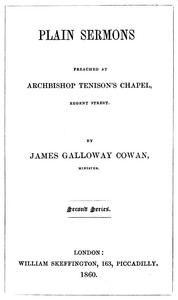
That rainy afternoon, the Paulist sermons’ quiet insistence that hardship sharpens faith lingered with me. Their plainness felt like a hand on my shoulder, not a lecture. Afterwards, idly tracing that theme through older collections, I found a gentler echo in Plain Sermons, preached at Archbishop Tenison's Chapel, Regent Street. Second Series — Themes and Context, the same steady pulse, but spoken in another century’s hush. It was a simple, unhurried discovery.
There are no reviews for this eBook.
There are no comments for this eBook.
Reader reflection
Record your reading impressions
A brief reflection can help important ideas stay with you longer.
Your progress
0
/
10
2
How much did you enjoy the reading experience?
3
Would you pass this book on to a friend?
4
How much effort did this book require?
5
Could you see yourself revisiting this book?
6
Would this book work well in a reading group?
7
Did this book create an emotional response?
8
Did anything about the book feel genuinely new?
9
In one sentence, what did you learn?
10